Pour Over Coffee: Four Variables, Only One Real Dial
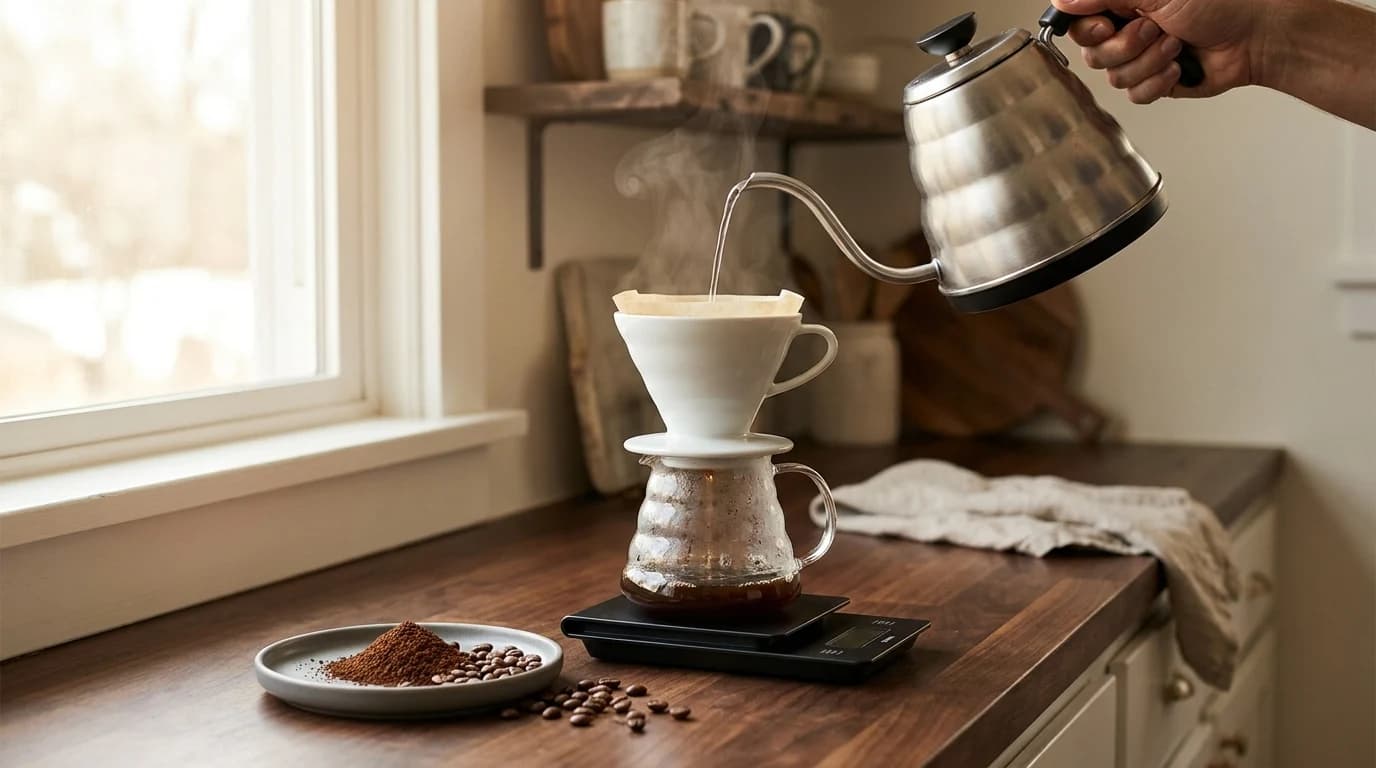
Ratio and grind do nearly all the work. Ratio sets strength and you can calculate it before you taste anything, so pick one figure between 1:15 and 1:17 and stop moving it. Grind sets extraction and is the only true dial — it is the single variable the SCA's own brewer certification adjusts to bring coffee into its target window. Water temperature is a gate: get into the 90 to 96 °C band the SCA specifies and stop there, because at a fixed brew strength and extraction, published sensory work found temperature made no appreciable difference. The pour matters mainly as mixing — a coherent stream from a gooseneck, not a choreography.
Key takeaways
- The four pour-over variables are not four dials: ratio is arithmetic, grind is the dial, temperature is a pass or fail gate, and the pour is a mixing input.
- SCA Standard 310-2021 fixes its test brew ratio at 55 g of coffee per 1.000 kg of water — that is 1:18.2, weaker than the 1:16 usually quoted as a rule.
- In that same standard, grind is the only variable adjusted to bring a brewer into the target extraction window; ratio, temperature and water are all held constant.
- Batali, Ristenpart and Guinard brewed at 87, 90 and 93 °C at matched brew strength and extraction yield, and a trained panel found no appreciable sensory difference from temperature.
- University of Pennsylvania physicists showed the pour works by mixing: a coherent laminar jet triggers repeating avalanches in the bed, while pouring too high breaks the stream into droplets and reduces the effect.
- The 1:16 ratio, the thirty-second bloom and the three-minute brew time are conventions — none of them appears in the SCA home brewer standard.
- The pour8.3BrewSift ScoreExcellent~$12.04Buy on AmazonRead review
- Grind, the dial8.1BrewSift ScoreExcellent
- Temperature gate8.4BrewSift ScoreExcellent~$119.97Buy on AmazonRead review
- Ratio, the arithmetic8.6BrewSift ScoreExcellent
Prices are approximate and change often. BrewSift earns a commission on qualifying purchases, at no extra cost to you.
Every pour-over guide hands you the same four knobs — ratio, grind, water temperature, pour — and a number for each. 1:16. Medium-fine. 205F. Three pours, thirty seconds apart. The implication is that missing any of them ruins the cup equally.
They do not. And they are not even the same kind of control. One is arithmetic you can do before tasting anything, one is the dial you actually turn, one is a gate you either clear or do not, and one is a mixing input with no published sensory standard behind it. Sorting them by type rather than importance is what stops a pour-over routine feeling like a ritual you might be performing wrong.
Four variables, four different jobs
| Variable | Kind of control | What it sets | How often to touch it |
|---|---|---|---|
| Brew ratio | Arithmetic | Strength — how much coffee ends up dissolved in the cup | Choose once, then leave it |
| Grind size | The dial | Extraction — how much of each particle dissolves | Every new bag, one step at a time |
| Water temperature | A gate | Whether extraction runs at a normal rate at all | Set the kettle and forget it |
| The pour | A mixing input | How evenly the bed wets and how long contact lasts | Repeat it; do not optimise it |
The frame: two of these you can reason about before tasting, one you can only find by tasting, and one you mostly just need to not get badly wrong.
Ratio: the only one you can predict
Brew ratio is the one variable you can work out on paper. Add more coffee to the same water and the drink gets proportionally stronger: you have not changed how much of each particle dissolves, only how many are in the bed.
The Specialty Coffee Association's home brewer standard pins this down. Every certification test in SCA Standard 310-2021 uses a fixed brew ratio of 55 g of coffee per 1.000 kg of water (§7.1.5), with the target defined as a brew strength of 1.15 to 1.55% dissolved solids at that ratio.
55 g/kg works out to 1:18.2 — weaker than the 1:16 usually quoted as gospel. That is a laboratory constant for certifying machines rather than a taste recommendation, but it does mean the famous number is convention, not specification.
| Ratio | For a 350 g mug | For a 500 g carafe | What it reads like |
|---|---|---|---|
| 1:15 | 23 g | 33 g | Heavy and syrupy; forgiving of a mediocre grinder |
| 1:16 | 22 g | 31 g | The common default |
| 1:17 | 21 g | 29 g | Lighter and more aromatic; punishes under-extraction |
| 1:18.2 | 19 g | 27 g | The SCA test ratio |
Our coffee ratio calculator will do the arithmetic for any dose. Then stop moving it: a ratio that changes every morning makes every other variable unreadable.
Grind: the dial the standard itself turns
Here is the detail that reorders the whole list. To bring a brewer into the target window, the SCA does not adjust the ratio, the temperature or the water flow. It adjusts the grind, and only the grind, within the particle limits of Table 2 (§7.4).
That table is specific. For a conical basket the final distribution must be less than 12% by mass above 850 µm, at least 68% between 425 and 850 µm, and 20% or less below 425 µm.
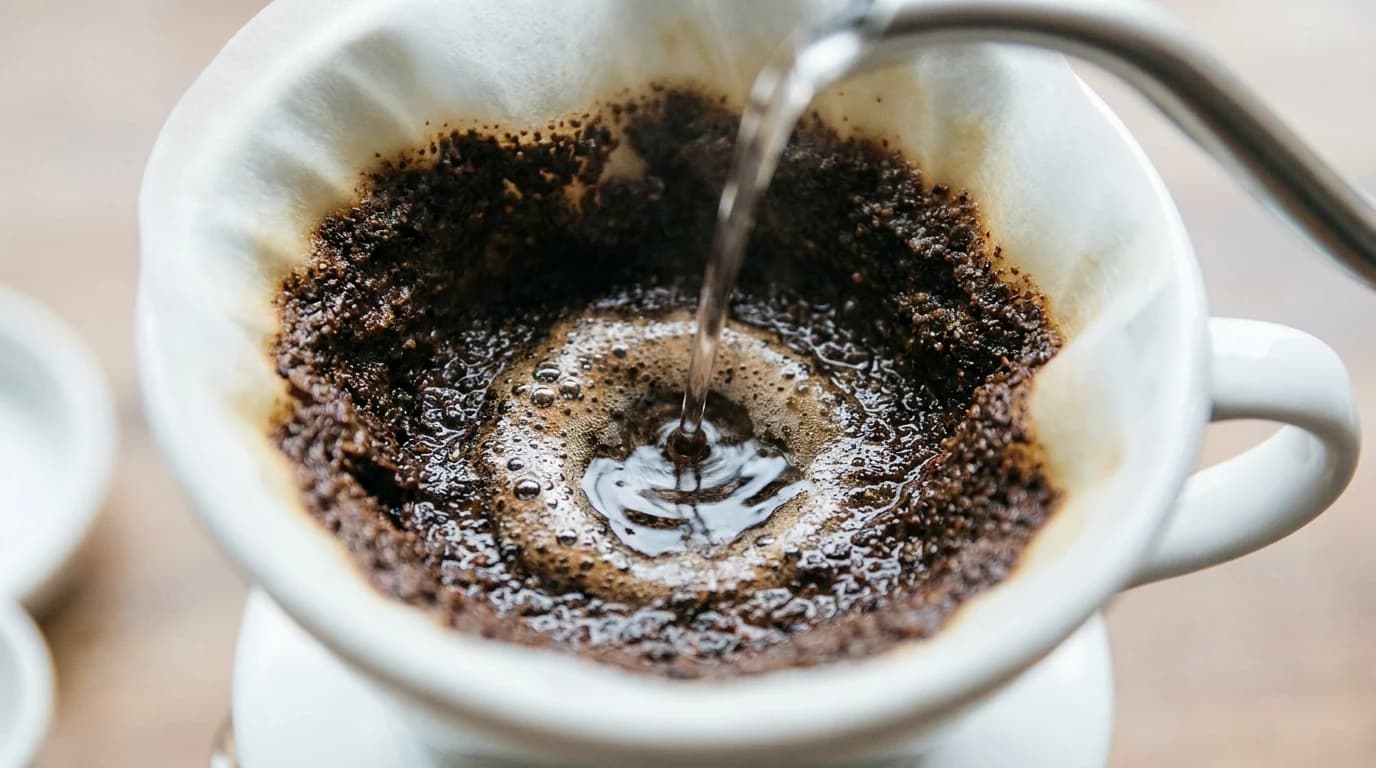
At your counter that reduces to two moves, and they are the only two:
- Finer — more surface area, slower drawdown, more extraction. Reach for it when the cup is sour, thin, or finishes abruptly.
- Coarser — less surface area, faster drawdown, less extraction. Reach for it when the cup is bitter, drying, or harsh.
Move one step at a time and taste in between. Settings do not transfer between grinders, which is why our grind size chart is built around texture and drawdown rather than numbers.
Temperature: a gate, not a dial
SCA 310-2021 §6.2 is strict here: the slurry must reach 90 to 96 °C by the moment a third of the water has been sprayed onto the bed, and stay there for the rest of the cycle. A brewer that cannot is non-compliant.
That reads like precision. Then UC Davis measured it. Batali, Ristenpart and Guinard brewed drip coffee at 87, 90 and 93 °C, adjusting grind and brew time so every batch landed on the same brew strength and extraction yield, then put the results in front of a trained descriptive panel. Brew strength had the largest sensory effect and extraction yield a smaller but real one — while temperature had no appreciable impact.
Read it this way: temperature is a gate to clear, not a dial to fine-tune. Where the brew ends up matters far more than the route it took.
In practice that is three lines of instruction:
- Boil, then pause. The familiar thirty-second wait is a convention rather than a measured rule, but with an ordinary kettle and a room-temperature dripper it lands you inside the band.
- Treat a variable-temperature kettle as a convenience, not a flavour upgrade.
The pour: a mixing input with no sensory standard
The pour attracts the most choreography and carries the least published evidence as a taste control. What it demonstrably does is mix. Physicists at the University of Pennsylvania imaged the inside of a brewing cone and described a cycle nobody had documented: the falling jet erodes a crater in the bed, grounds pile up at its edge, the wall collapses in a miniature avalanche, and it starts again — continuous mixing for as long as you pour. Two useful things fall out of that.
What the imaging supports:
- A coherent, laminar stream. This is the real argument for a gooseneck spout, and it is why the researchers frame the result as reaching a given strength with fewer beans.
- A little height. More height drives more agitation, and more agitation keeps the bed mixing.
What it does not support:
- Pouring from very high. Past a point the stream breaks into droplets and drags air into the bed instead of digging into it.
- Choreography as a flavour claim. The imaging used transparent silica gel rather than coffee, the confirmation runs measured dissolved solids, and nobody tasted anything.
For the spout question on its own, gooseneck vs regular kettle is the longer answer.
What to change when it tastes like that
| The cup tastes | Control at fault | Change this first | Go deeper |
|---|---|---|---|
| Sour, thin, salty, finishes abruptly | Grind | One step finer | Why is my coffee sour |
| Bitter, drying, harsh, lingering | Grind | One step coarser | Sour vs bitter |
| Balanced but watery | Ratio | More coffee, same water | Do you need a scale |
| Balanced but heavy and muddy | Ratio | Less coffee, same water | Do you need a scale |
| Flat or papery whatever you do | Neither — water or beans | Check hardness and roast date | Hard water and coffee |
Grind and ratio between them account for nearly every complaint on that list. That is the same ranking, arrived at from the other end.
What we could not source
The canon carries three numbers everyone repeats: 1:16, a thirty-second bloom, and a two-and-a-half to three-and-a-half minute brew. We could not trace any of them to a published standard or a peer-reviewed measurement. SCA 310-2021 specifies temperature, a test brew ratio, water chemistry and a grind distribution, and says nothing about bloom time or pouring pattern.
That does not make them wrong — defaults thousands of people converge on are usually defensible. It does mean that if you are treating a thirty-second bloom as a rule you keep failing, you are being harder on yourself than the evidence is.
Your next step
The gear that makes these variables repeatable.
One piece of kit per variable, and nothing beyond that
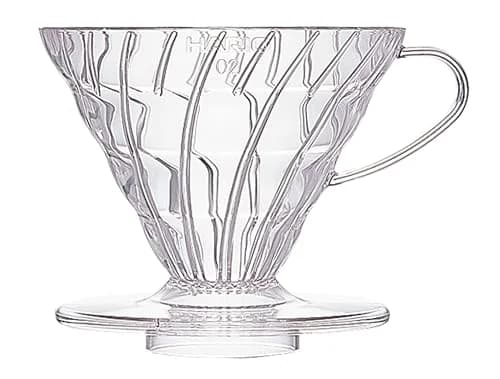
V60 Pour-Over Coffee Dripper 02
The iconic pour-over cone — a clean, bright, articulate cup if you bring a gooseneck and a little technique.
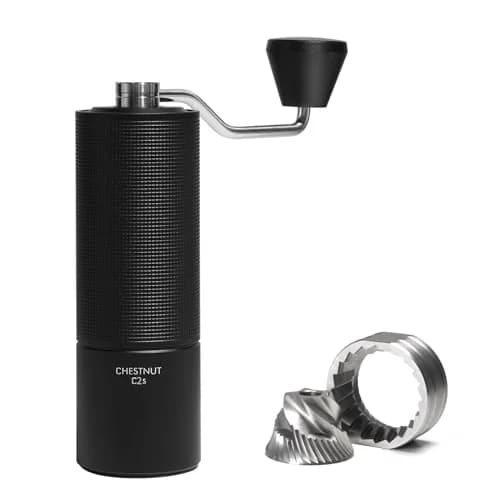
Chestnut C2S
The budget hero — steel burrs and a clean filter grind for the price of a few bags of beans.
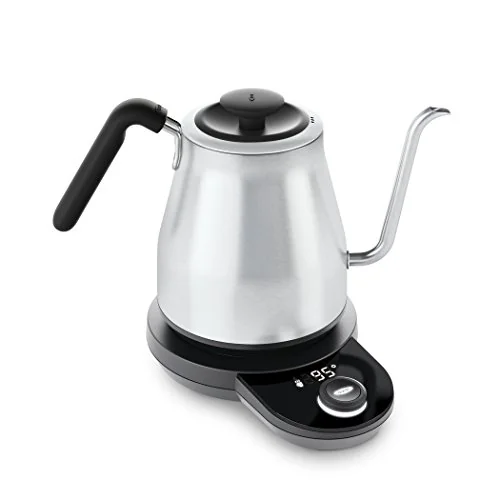
Brew Adjustable Gooseneck
Variable-temp gooseneck pouring for a third less than a Stagg, with a larger capacity.
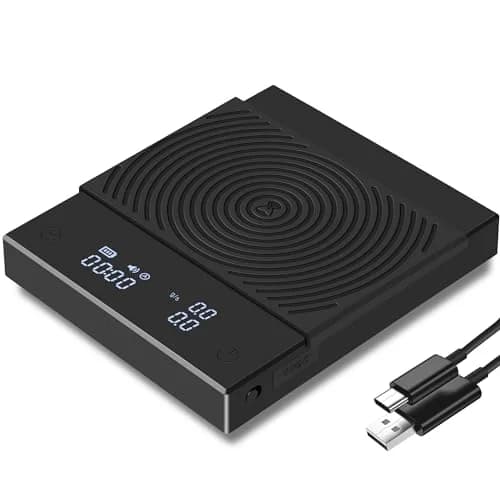
Black Mirror Basic 2
Acaia-style 0.1g performance and a fast refresh for less than half the price.
BrewSift earns a commission on qualifying purchases made through these links, at no extra cost to you. Prices shown were checked on publication and change often.
FAQ
What is the best coffee-to-water ratio for pour over?
There is no standardised answer, which is itself useful to know. Most pour-over guides converge on somewhere between 1:15 and 1:17, and that is convention rather than specification. The one published figure is the SCA home brewer standard's test ratio of 55 g of coffee per 1.000 kg of water, which is 1:18.2 — a laboratory constant for certifying machines, not a taste recommendation. Pick a figure in the 1:15 to 1:17 range, brew it for a week, and adjust once you know what your default tastes like.
Does water temperature really not matter for pour over?
It matters as a range, not as a target. The SCA home brewer standard requires the slurry to sit between 90 and 96 °C for a brewer to be certified. But when Batali, Ristenpart and Guinard brewed at 87, 90 and 93 °C and adjusted grind and time so every batch hit the same brew strength and extraction yield, a trained sensory panel found no appreciable difference attributable to temperature. Get into the band with water taken off the boil, then spend your attention on grind.
Do I need a gooseneck kettle for pour over?
It is the one piece of kit with a mechanical argument behind it. Research from the University of Pennsylvania found that a coherent, laminar stream is what drives the repeated avalanches that keep the coffee bed mixing, and that a stream breaking into droplets from too great a height does the job less well. A wide household spout cannot produce that stream reliably. Variable temperature control on the same kettle is a convenience rather than a flavour upgrade.
Should I change grind or ratio first when the coffee tastes wrong?
Grind, almost always. Sour, thin and abrupt means under-extraction, so go one step finer; bitter, drying and lingering means over-extraction, so go one step coarser. Ratio is the right lever only when the cup tastes balanced but simply too weak or too heavy — that is a strength problem, not an extraction problem. Change one variable at a time and taste in between, or you will not know which move did what.
How long should the bloom last?
Thirty to forty-five seconds is the usual advice and it is a reasonable default, but we could not trace it to any published standard or measurement. The SCA home brewer standard specifies water temperature, a test brew ratio, water chemistry and a grind particle distribution, and says nothing at all about blooming or pouring pattern. Treat it as a sensible convention rather than a rule you are failing.
Sources
- SCA Standard 310-2021, Home Coffee Brewers: Specifications and Test Methods (PDF) — §6.2 brewing temperature 90–96 °C reached by 33% of water sprayed; §7.1.3 and Table 2 grind particle distribution; §7.1.5 standard brew ratio of 55 g coffee per 1.000 kg water; §7.4 grind adjusted (alone) to reach the target extraction parameters of 1.15–1.55% brew strength
- Batali, Ristenpart & Guinard (2020), Scientific Reports 10:16450 — Brew temperature, at fixed brew strength and extraction, has little impact on the sensory profile of drip brew coffee (87/90/93 °C; TDS had the greatest sensory impact, percent extraction a lesser one, temperature none appreciable)
- Specialty Coffee Association news — Just Published: Brewing Temperature and the Sensory Profile of Brewed Coffee (the SCA's own write-up of the UC Davis temperature study)
- University of Pennsylvania research release on Park, Young & Mathijssen (2025), Physics of Fluids 37:043332, doi 10.1063/5.0257924 — pour height, laminar jet coherence and avalanche mixing in a pour-over cone, including the droplet break-up limit and the silica-gel imaging caveat