Coffee Grind Size Chart: Dial In by Taste, Not Numbers
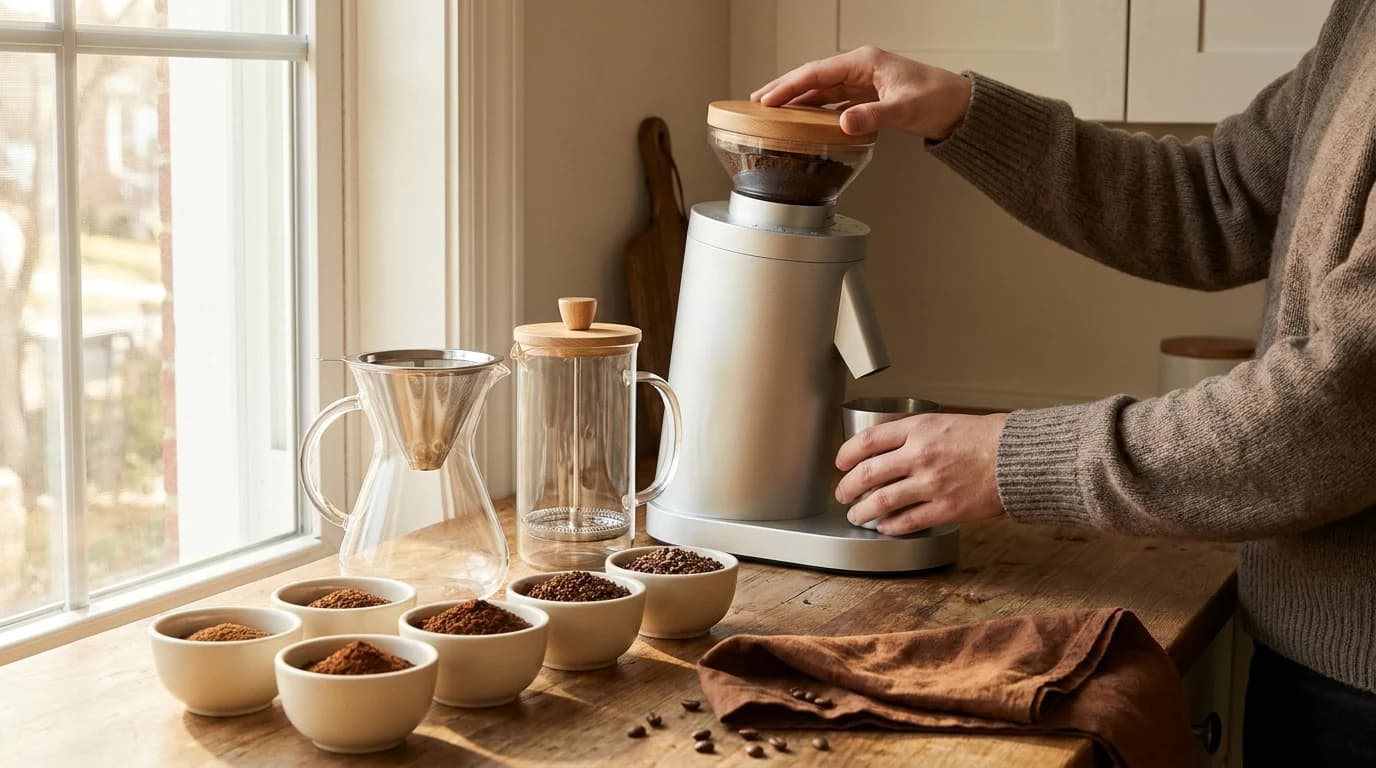
There is no universal grinder number for pour-over, espresso, or French press. The same setting number produces different particle sizes across grinder models and even between calibrated units. Use a texture as the starting point, then brew once and adjust by outcome: sour, weak, or unusually fast usually calls for a finer grind; bitter, dry, stalled, or unusually slow usually calls for a coarser grind. Change only grind size until the cup moves in the right direction.
Key takeaways
- Grinder numbers are local coordinates. A 12 on one grinder is not a 12 on another, so copy texture and outcome, not the dial label.
- Long contact wants coarse coffee; pressure or a short brew wants fine. That is why Turkish and espresso sit at one end of the chart and French press and cold brew at the other.
- Time is a diagnostic, not the goal. A brew window tells you when flow is unusual; taste decides whether the adjustment helped.
- Sour and fast usually means finer. More surface area raises extraction when dose, water, and technique stay fixed.
- Bitter, dry, or stalled usually means coarser. Move one small step and brew again before changing any other variable.
A coffee grind chart should get you into the neighborhood. It cannot give you a house number. The setting printed on your grinder is not a standard unit: a 12 on one model can be finer than an 8 on another, and two units of the same model can land differently after calibration and wear.
That makes most number-based charts falsely precise. The useful chart pairs a starting texture with a contact-time window and, most importantly, what the cup tells you to do next.
Grind size by method: start here, then taste
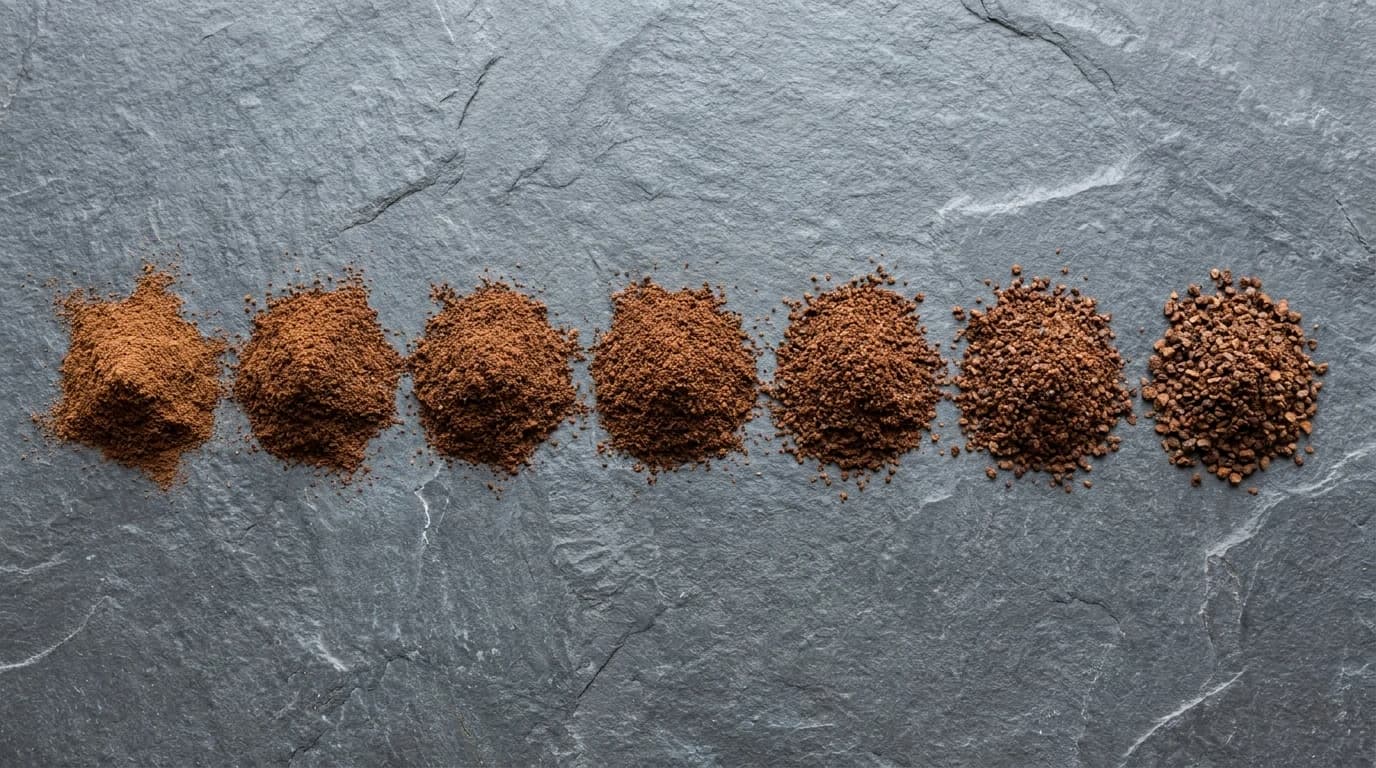
| Brew method | Starting texture | Practical contact window | If sour, weak, or fast | If bitter, dry, or slow |
|---|---|---|---|---|
| Turkish | Extra-fine powder, like flour | Brewed in the pot, never filtered | Finer; most home grinders cannot reach it | Coarser |
| Espresso | Very fine, finer than table salt | 25–35 sec for a typical shot | Finer, unless channeling is obvious | Coarser |
| Moka pot | Fine, but less fine than espresso | Flow should be steady before the final sputter | Slightly finer | Coarser; also lower the heat |
| AeroPress | Medium-fine | 1–3 min | Finer or extend steep slightly | Coarser or shorten steep |
| Pour-over | Medium, near table salt | 2:30–4:00 for many recipes | Finer | Coarser |
| Chemex | Medium-coarse, coarse sand to sea salt | Slower than a thin cone, because of the thick filter | Finer | Coarser |
| Auto drip | Medium | 4–6 min for a full batch | Finer | Coarser |
| French press | Medium-coarse to coarse | 4–5 min | Finer | Coarser |
| Percolator | Coarse, like sea salt | Water recirculates through the grounds | Finer | Coarser |
| Cold brew | Coarse | 12–18 hr | Finer before adding hours | Coarser or shorten steep |
These windows are diagnostic starting points, not competitions. A one-cup pour-over and a large Chemex should not finish together. An immersion AeroPress can taste excellent outside the listed time. Use the window to notice an extreme; use flavor to choose the direction.
Why each method wants its grind
Three things set how fast water pulls flavor out of the grounds, and grind is the knob that balances them against each other:
- Contact time. The longer water sits on the grounds, the more it extracts. The National Coffee Association's rule of thumb is that the longer the contact, the coarser the grind, which is why espresso is fine and cold brew is coarse.
- Pressure. Forcing water through speeds extraction, so espresso and the moka pot need a finer, tighter bed to slow the flow.
- Filter type. A thick paper filter slows drawdown and traps fines. A metal mesh lets fines into the cup, so it wants coarser coffee.
Read the chart with those three in mind and the pattern is plain:
- Turkish is the finest because it brews unfiltered and the powder has to settle slowly; cold brew is the coarsest because it steeps for hours.
- Espresso and moka sit fine because something is pushing water through.
- Chemex sits a step coarser than a V60 for the same cone shape, purely because its paper is much thicker.
The rule beneath the chart
Counter Culture Coffee's grind guide makes two points that matter more than the labels. First, grinder settings are far from universal. Second, when other variables stay fixed, a finer grind exposes more surface area and generally raises extraction.
That gives you a compact troubleshooting model:
- Sour, thin, weak, or fast: the water probably did not extract enough. Move finer one small step.
- Bitter, ashy, drying, or stalled: the brew may be extracting too much or flowing unevenly. Move coarser one small step.
- Both sour and bitter: suspect uneven extraction. In espresso that may mean channeling; in pour-over it may mean an uneven bed or pour. Grinding ever finer can make this worse.
- Strong but sour: strength and extraction are different. Add water only if the concentration is the problem; adjust grind if the flavor is underdeveloped.
Telling sour from bitter when you are learning
The words "sour" and "bitter" are imperfect, especially at first. Focus on direction and on how long the sensation lasts:
The lingering test: sourness feels sharp and disappears quickly, like lemon juice. Bitterness and astringency linger and dry the mouth, like over-steeped tea. If the sensation is gone before you swallow, go finer. If it is still there afterwards, go coarser.
The one-variable dial-in loop
A good grinder matters because it lets you repeat this loop with smaller, more even changes. That is the practical difference behind blade versus burr grinders, not a magical setting number.
- Lock the recipe. Keep coffee dose, water weight, temperature, and pouring or steeping method the same.
- Choose the chart's starting texture. Use the visual description or your grinder maker's method range, never a stranger's number alone.
- Brew and record the actual time. Do not stop a tasty immersion brew merely because the clock differs; note it.
- Name the dominant problem. Sour/weak/fast points finer. Bitter/dry/slow points coarser.
- Move one small step. On a stepless espresso grinder, make a tiny change. On a stepped filter grinder, move one click.
- Repeat before changing anything else. Stop when the cup gains sweetness and balance, even if the final number contradicts a chart.
A simple note such as "V60, 20 g / 320 g, setting 17, 3:05, slightly dry" is more reusable than a universal chart because it records your grinder, your recipe, and an outcome.
What to write down, and what to ignore
Worth recording:
- Your grinder model and setting
- Dose and water weight in grams
- Actual brew or drawdown time
- One flavor word for the dominant defect
Not worth recording:
- Someone else's setting number for a different grinder
- Scoop counts or volume measures
- Water temperature you did not actually measure
- A time you stopped early to hit a target
Method-specific traps
Espresso: time can hide channeling
A 30-second shot can still taste both sour and harsh if water found fast paths through part of the puck and over-extracted the rest. Before chasing the dial, make distribution and tamp repeatable. Then use grind to steer flow. Our sour vs bitter espresso guide works through the contradictory cases.
Pour-over: the grinder is not the only brake
Agitation, filter clogging, pour height, and a deep coffee bed all affect drawdown. If one click coarser barely changes a stalled brew, reduce unnecessary swirling or pouring violence rather than jumping five settings.
Moka pot: bitterness may be heat
A too-fine grind can slow flow, but aggressive heat and a long final sputter also produce a harsh cup. Our bitter moka pot fix separates the heat, water, and grind problems.
Chemex: the filter sets the grind
The Chemex filter is far thicker than a standard cone's, and it slows the drawdown so much that a medium grind can clog it and back up. Medium-coarse restores the flow. If it still stalls, go a step coarser before blaming your pour.
French press and percolator: coarse, behind metal
A French press steeps about four minutes behind a metal mesh, so any fines slip through as silt. A percolator recirculates water through the grounds again and again, so it also needs a coarse grind to avoid a harsh, over-brewed pot. Once the grind is right, our French press ratio by press size gives the grams.
Why metal mesh forces coarse: paper catches fines, metal does not. Anything smaller than the screen ends up in your cup, still extracting while you drink it.
Turkish: beyond most home grinders
UNESCO's description of the tradition has the beans ground to a fine powder and brewed slowly in the pot, unfiltered, so Turkish sits finer than espresso. Many hand grinders and most electric filter grinders cannot get there, which is why Turkish setups usually pair the cezve with a dedicated Turkish mill. Forcing a filter grinder to its finest setting gives an uneven powder, not a true Turkish grind.
Cold brew: strength is not extraction
If concentrate tastes weak after dilution, change the coffee-to-water ratio before extending the steep indefinitely. Use the coarse range as a clean starting point, then follow the ratio and time method in our cold brew concentrate guide.
What to look for in a grinder
The best grinder for dialing in is not the one with the largest number range. It is the one that changes predictably, returns to a prior setting, and is appropriate for the method. Espresso needs very small adjustments; filter brewing can work with wider steps. Browse the grinder guide by that job, and use the grind size tool to convert a target texture into a starting point for your model.
Your grinder's number is useful. It is just private. Record it after the cup tastes right, not before, and the false precision disappears.
Your next step
Dial in faster with the right grinder.
Grinders that hold a setting
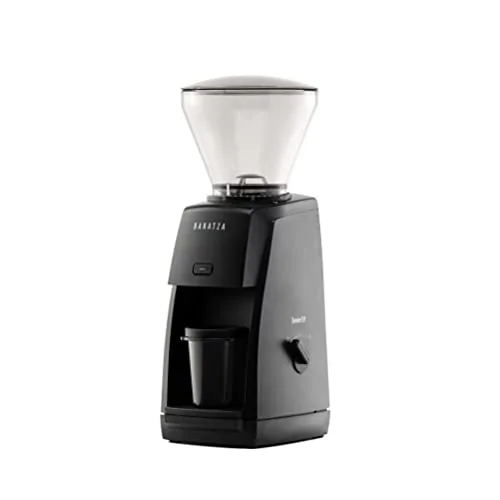
Encore ESP
The grinder most people should buy first — it does espresso and filter, and Baratza will fix it forever.
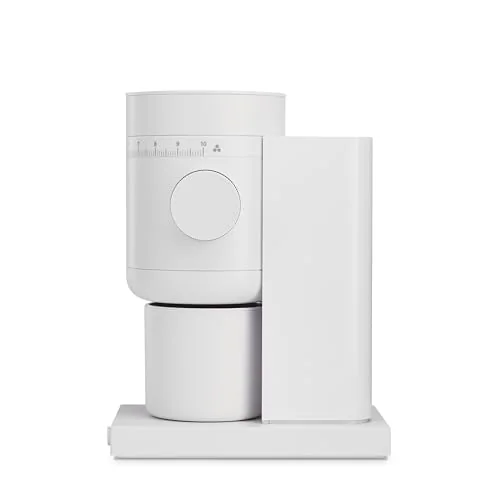
Opus 2
Fellow's all-rounder, now in its second generation: a wide espresso-to-cold-brew range and a design that earns its counter space.
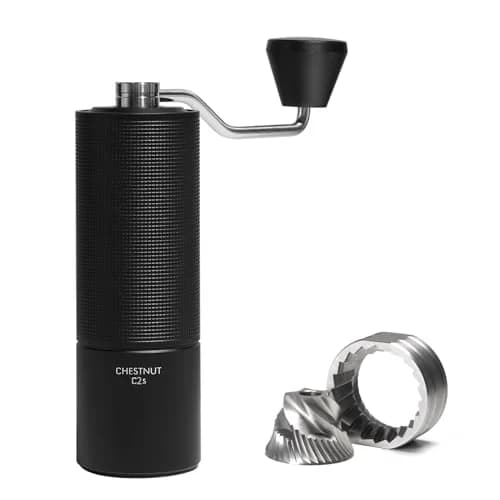
Chestnut C2S
The budget hero — steel burrs and a clean filter grind for the price of a few bags of beans.
BrewSift earns a commission on qualifying purchases made through these links, at no extra cost to you. Prices shown were checked on publication and change often.
FAQ
What grind size should I use for pour-over coffee?
Start at medium, around table salt, for most cone and flat-bottom pour-overs. If the water drains unusually fast and the cup tastes sour or thin, go finer. If it stalls and tastes bitter, harsh, or dry, go coarser. Brewer shape, dose, filter, and coffee all shift the final setting.
Does a higher grinder number mean coarser coffee?
Often, but not universally. Check your grinder's markings or manual. More importantly, the number is meaningful only on that grinder: different models use different ranges, and calibration changes where a given particle size lands.
Why is my coffee sour even at the recommended grind size?
The recommendation is only a start. Hold dose, ratio, water temperature, and technique steady, then move one small step finer. If brew time lengthens and the cup gains sweetness and balance, keep going cautiously. If it becomes dry or bitter, step back.
Should I change grind size or brew time first?
For a repeatable recipe, keep your intended technique and target contact time steady and change grind size first. Grind changes also alter flow, so the actual time may move. Change one variable per brew or you will not know which adjustment fixed the cup.
Why does espresso need a much finer grind than French press?
Espresso forces water through a compact puck under high pressure in roughly half a minute, so the water needs a lot of surface area to extract enough in that short time, which means a fine grind. A French press steeps for about four minutes with no pressure, so a coarse grind gives the water all the contact it needs without over-extracting.
Can I use one grind size for every brew method?
Not well. A medium grind is a passable compromise for drip and pour-over, but it will choke an espresso machine and run weak and sour in a French press. Each method has its own contact time, pressure and filter, so each has its own starting grind, which is exactly why an adjustable burr grinder matters.
How fine is fine enough for Turkish coffee?
Finer than espresso, close to flour or powdered sugar. The coffee is brewed in the pot and never filtered, so the particles have to be fine enough to settle slowly. Most home grinders cannot reach that texture, which is why Turkish coffee is traditionally ground on a dedicated hand mill.
Sources
- Coffee Basics: Grind Size — settings are not universal; finer grinding raises extraction; adjust by taste and brew time (Counter Culture Coffee)
- Switching Grind Settings with Confidence — manufacturer guidance on dialing and moving between settings (Baratza)
- National Coffee Association — French press coffee (the longer the contact time, the coarser the grind; grind-size table by brew method)
- UNESCO Intangible Cultural Heritage — Turkish coffee culture and tradition (beans ground to a fine powder and brewed slowly in the pot)