Precision scales with 0.1g resolution and a built-in timer take the guesswork out of every brew. The cheapest upgrade that makes your coffee repeatable.
Quick steer — A scale is what makes a good cup repeatable rather than lucky. Espresso wants 0.1 g resolution and a fast refresh; filter brewing does not.
Skip this
A scale bought on a 0.1 g headline without reading the range that figure applies to
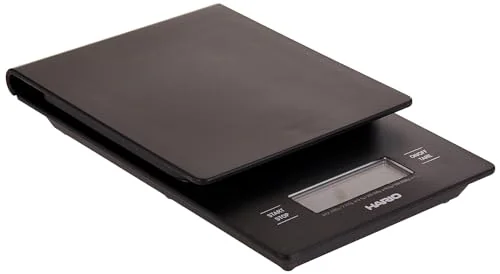
Coffee scales commonly step their resolution as the load increases. Hario publishes the V60 Drip Scale as 0.1 g from 2 g to 200 g, 0.5 g from 200 g to 500 g and 1 g above that, so once a cup, a saucer or a portafilter is sitting on it the display has stopped resolving tenths. If the scale will live on an espresso drip tray, check the resolution at the weight it will actually carry.
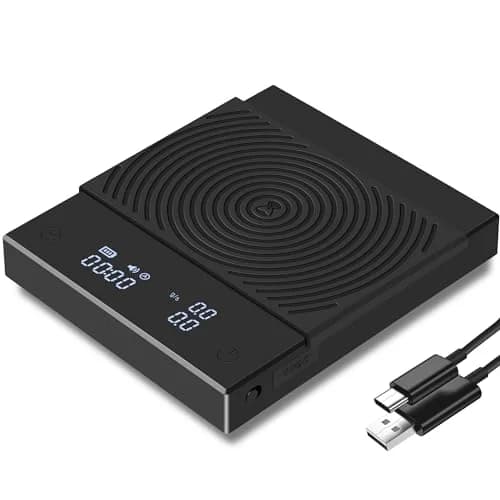
The one to buy if you want espresso-grade weighing without the Acaia premium: 0.1 g resolution, a fast refresh and a built-in timer with espresso and pour-over auto modes. Step up to the Fellow Tally Pro only if the design and brew-studio modes are what you are paying for.
The BrewSift Score is a 0–10 weighted average of category-specific sub-scores, built from manufacturer specifications, published reviews and aggregated owner reports — not hands-on testing. In this category it weights accuracy 30%, responsiveness 25% and features 20%, plus 2 smaller factors. How we score →
The pro standard: 0.1g resolution, a lightning-fast refresh, flow-rate data, and a brewing app.
Acaia's Pearl reads to 0.1g, updates fast enough to watch espresso flow in real time, and pairs with brewing apps for pour-over guidance and shot logging. It's the scale serious home baristas reach for; the price is the only real knock.
Acaia-style 0.1g performance and a fast refresh for less than half the price.
0.1g resolution, a quick refresh, built-in timer, and auto modes for espresso and pour-over — the value champion that gives most home baristas everything they need without the Acaia premium.
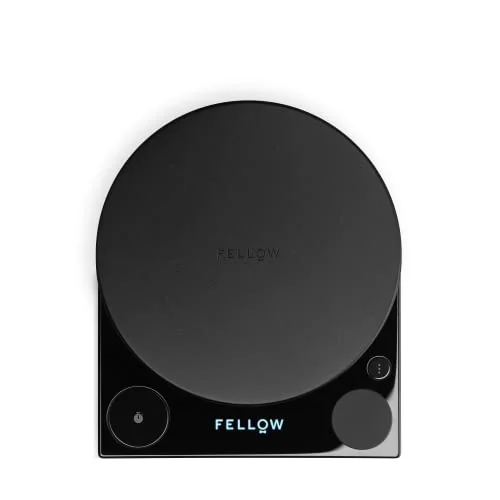
Fellow's precision scale with brew-studio modes and the cleanest design on the counter.
0.1g resolution, a 2.5 kg capacity, a Brew Assist mode that guides you to your target brew weight from a chosen ratio, and the polished Fellow industrial design. It overlaps the Acaia on price; pick it on aesthetics and the ratio-coaching features if those matter to you.
The 0.1 g on the box is often a range rather than a rating. Hario's published specification for the V60 Drip Scale reads 0.1 g between 2 g and 200 g, 0.5 g up to 500 g and 1 g beyond that — so the tenths disappear at exactly the loads espresso puts on a scale, once a cup and a portafilter are on the platform. Acaia publishes a flat 0.1 g readability to its full 2,000 g capacity instead, and that difference, not the number on the marketing page, is most of what separates a brewing scale from a kitchen one.
What owners actually report
r/espressor/pouroverr/Coffee
r/espresso and r/pourover treat a scale as the cheapest thing on the bench that turns a good cup into a repeatable one, and the argument there is never about accuracy — it is about responsiveness. The recurring complaint is lag: a scale that updates slowly leaves you pouring past your target, which is why the subs keep steering people away from flat kitchen scales for pour-over even while agreeing the kitchen scale's accuracy is fine. Timemore's Black Mirror is the name that comes up most as the sensible buy, described as doing the important parts of an Acaia for a fraction of the money, and the Acaia Pearl is talked about as an upgrade in feel and software rather than in the coffee it produces — owners say so openly. The other thread that never goes away is water: espresso scales live in steam and drips, and a scale killed by moisture is the most common reason people give for having bought a second one.
Consistently praised
Timemore Black Mirror — The most repeated buy-this-one in these threads: owners describe espresso-grade resolution and a display fast enough to pour against, without the Acaia price.
Acaia Pearl — Recommended for people who brew daily and want the software and the feel. Acaia publishes a flat 0.1 g readability across the full 2,000 g capacity and a rechargeable cell rated for 30 to 40 hours, and owners cite the auto-start timer as the feature they miss on everything else.
A plain kitchen scale, for filter brewing — The honest minority answer that keeps resurfacing: for a V60 or a batch brew, owners say a 1 g kitchen scale with a tare button makes the same coffee and that the upgrade money belongs in the grinder.
Consistently warned about
Aggressive auto-off — The single most repeated annoyance in the category is a scale that powers down mid-bloom. Experienced owners check the auto-off behaviour before they check the resolution spec.
Unsealed scales under a group head — Hario states plainly that the V60 Drip Scale is not water resistant, and drip-tray casualties are a running theme. The advice is a sealed scale, or a tray between the scale and the machine.
Chasing 0.01 g — Jeweller's-resolution scales get talked out of espresso threads regularly: the extra decimal is not usable in a coffee workflow and the finer load cell usually means a slower, more damped display.
What we didn't pick
Popular options we looked at and passed on, with the specific reason each one fell short.
0.01 g jeweller's scales sold for espressoConsidered 2026-09
The extra decimal place is not usable anywhere in a coffee workflow, and a finer load cell typically comes with a slower, more heavily damped display. Espresso dosing works at 0.1 g, and refresh speed is what the difference should be spent on.
App-only Bluetooth scalesConsidered 2026-09
A scale you cannot read without unlocking a phone is a scale you stop reading mid-pour, and an app dependency leaves a brewing tool exposed to a phone OS update. We would rather rank a scale with a good on-device display.
5 kg kitchen scales with 1 g stepsConsidered 2026-09
Genuinely fine for filter brewing and the honest cheap answer, but out of scope for this ranking: at 1 g steps an espresso dose and yield are not resolvable, and the wide flat platform rarely fits on a drip tray.
The four scales BrewSift ranks run $49.69 to $199.95, a 4x spread, and every one of them offers 0.1 g resolution somewhere in its range. What separates them is the load at which that resolution stops.
Resolution and what it's for
Resolution is the smallest change the scale can read. 0.1g resolution is what you want for espresso, where a fraction of a gram in the dose or yield noticeably changes the shot. For pour-over and larger brews, 1g resolution is perfectly adequate since you're working with hundreds of grams of water. A scale that reads 0.1g up to a few hundred grams covers both espresso dosing and brewing; you rarely need the 0.01g jeweler's precision some scales advertise, and chasing it can actually slow the display down.
Refresh speed and responsiveness
For pour-over and espresso, how fast the number updates in real time often matters more than absolute precision — you're watching the weight climb as you pour or as the shot flows, and a laggy scale leaves you pouring blind and overshooting. A responsive scale keeps up with the stream so you can hit your target water weight or espresso yield exactly. This is the single biggest practical difference between a cheap kitchen scale and a purpose-built coffee scale, and it's why the Acaia and Timemore brewing scales are favorites.
Built-in timer and flow features
A built-in timer is what turns a scale into a brewing tool: it lets you track weight and time together so you can hit a target ratio on a repeatable schedule (for example, 30g bloom by 0:30, finish pour by 1:30). Better coffee scales start the timer automatically when water first hits, and some display flow rate or auto-tare the cup. You can brew with a separate phone timer, but having weight and time on one screen, hands-free, is far less fiddly mid-pour.
Size, water resistance, and battery
Practical details decide whether a scale survives daily use. It needs to physically fit under your espresso machine's group head and portafilter, or on the drip tray — a common reason a scale gets returned. Water and steam are constant around espresso, so at least splash resistance matters; fully sealed scales last longest. Consider whether it runs on replaceable batteries or USB-rechargeable, and whether the auto-off timer is short enough to save power but long enough not to shut off mid-brew (an annoyance on cheap scales).
Do you need a coffee scale? It depends on your method
How much a scale matters depends on how fast and unforgiving your brew method is, not on how much your machine cost. What a scale removes is drift: a scoop measures volume, and beans of different roasts and sizes pack differently, so the same scoop delivers a different dose from one bag to the next. Espresso is where a scale is essential. A shot is a small dose pushed through fast, small changes in dose or yield noticeably change it, and crema makes the yield impossible to judge by eye, so you weigh both the coffee in and the espresso out, ideally to 0.1 g. Pour-over comes next: the water runs through quickly and the window is narrow, so a scale and a timer are what turn a lucky cup into a repeatable one. A drip machine is forgiving, but a steady dose still makes it consistent. French press and cold brew are where a scale matters least: a long steep and a generous ratio window absorb a few grams, and cold brew concentrate gets diluted to taste anyway, so any kitchen scale with 1 g steps and a tare button, or a careful scoop, is plenty. Two honest limits. If every cup is consistently bitter, sour or flat, a scale will not fix it: an even grind from a burr grinder, fresh beans and decent water move flavour more than weighing a dose you are already roughly hitting. And a dedicated coffee scale earns its premium over a kitchen scale mainly for espresso and pour-over, through 0.1 g resolution, a fast refresh, a built-in timer and a footprint that fits on a drip tray.
What is the best coffee scale for espresso and pour-over?
For most people, the Timemore Black Mirror Basic 2. It reads to 0.1 g, holds 2 kg, refreshes fast and has a built-in timer with auto modes for espresso and pour-over, which covers both jobs. If you only brew pour-over, the Hario V60 Drip Scale is Hario's own scale, sized for a V60 and carafe; Hario publishes it as 0.1 g up to 200 g and coarser above that, which is fine for filter but not for weighing a shot with a cup on the platform. The Acaia Pearl is the reference the others are measured against, with a flat 0.1 g readability across its 2,000 g capacity, but it is not sold on Amazon, so we cannot link it.
Do I really need a coffee scale?
It depends on how you brew. For espresso a scale is close to essential, because you weigh both the dose and the shot, and small changes in either noticeably change it. For pour-over it is what makes a good cup repeatable rather than lucky. For a drip machine it helps keep the dose steady, and for French press or cold brew it is optional, because a long steep and a wide ratio window absorb a few grams. The underlying reason is that a scoop measures volume and beans vary in density, so the same scoop is not the same dose from bag to bag. Any kitchen scale with a tare button is a fine start; a dedicated coffee scale adds 0.1 g resolution, a fast refresh and a timer.
Should I buy a coffee scale or a grinder first?
If your coffee tastes bad rather than inconsistent, a burr grinder first. An even grind changes extraction more than a precisely weighed dose you were already roughly hitting. Buy the scale once the grind, beans and water are sorted and you want to repeat a good cup rather than rescue a bad one.
What scale resolution do I need for espresso?
0.1g resolution is the standard for espresso, because a few tenths of a gram in your dose or your yield measurably shifts the strength and extraction of a shot. For pour-over and batch brewing, 1g resolution is plenty since you're measuring hundreds of grams of water. You don't need 0.01g precision for coffee — it's overkill, and chasing it can slow the scale's response, which matters more day to day than the extra decimal place.
Why does a coffee scale need a built-in timer?
Because good brewing tracks weight and time together. A timer lets you hit a repeatable recipe — for example, bloom to 30g by 30 seconds, finish the pour by 90 seconds — so every cup follows the same schedule. Having weight and time on one hands-free screen is far less fiddly than juggling a phone timer while pouring, and the best coffee scales start the timer automatically when the first water hits. It's the feature that turns a scale from a measuring tool into a brewing tool.
Can I use a regular kitchen scale for coffee?
Yes, especially for pour-over and general brewing — a flat kitchen scale with 1g resolution and a tare button will weigh your coffee and water just fine. Its limits show up with espresso, where you want 0.1g resolution, and with pour-over precision, where a slow refresh rate makes it hard to hit a target as you pour. A cheap kitchen scale is a completely reasonable way to start; upgrade to a dedicated coffee scale when you want faster response, finer resolution, and a built-in timer.
Are expensive coffee scales like Acaia worth it?
They're worth it for people who brew espresso or pour-over daily and value the experience: fast, responsive weight readings that keep up with the pour, an accurate auto-starting timer, flow-rate displays, water resistance, and a footprint designed to fit under a machine. The coffee they help you make isn't magically better than what a good budget coffee scale produces — the premium buys responsiveness, durability, and polish. If you're starting out or brew casually, a sub-$50 coffee scale (or even a kitchen scale) gets you most of the benefit for a fraction of the price.