Chemex vs Hario V60
Short answer: Buy the Chemex if you brew for two or three people and want the cleanest cup on the counter; buy the Hario V60 if you brew one or two cups and want the brightest, most aromatic one for a fraction of the money. The Chemex is a pour-over and a carafe in one piece of glass, and its bonded filters are thick enough to strip out most oils and fines, which is exactly why the cup tastes so clean and why the brew runs slow. The V60's 60-degree cone, spiral ribs and single large hole hand you control of the flow instead, rewarding a steady pour with more aroma and more clarity of flavour. Both want a gooseneck kettle.
Updated
Part of our guide to the best manual brewers.
Head to headHighest overall score: Hario V60 Pour-Over Coffee Dripper 02 (7.9 vs 8.3) — but pick by how you brew.
 | 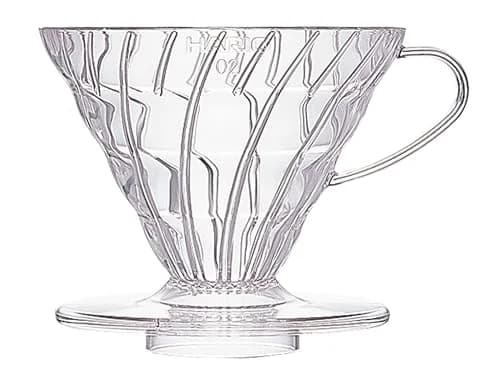 | |
|---|---|---|
| Score | 7.9/ 10 | 8.3/ 10 Higher |
| Price | $47.03approx.Checked 2026-10-09 | $12.15approx.Checked 2026-10-21 |
| Get it for | serving two or three, cleanest, lowest-sediment cup | lowest price, brightest, most aromatic cup, durability |
| Method | Pour-over carafe | Pour-over |
| Filters | Chemex Bonded FP-1, FC-100, FS-100, FSU-100 | V60 paper, size 02 |
| Capacity | 6 cups, 30 oz (Chemex; 5 oz per cup) | 1–4 cups (Hario) |
| Sizes | Classic 3 / 6 / 8 / 10 cup (Chemex) | 01 (1–2 cups) / 02 (1–4) / 03 (1–6) |
| AmazonFull review of Chemex Classic 6-Cup | AmazonFull review of Hario V60 Pour-Over Coffee Dripper 02 |
Prices are approximate; use the listing for the current offer.
What the extra money buys — The Chemex costs meaningfully more than a V60 dripper, and its bonded filters cost more per brew too. That money buys the carafe: one piece of glass that brews and serves two or three people, plus the thick filter that makes the cleanest, lowest-sediment cup of the two. The V60 gives up the carafe and the scale, and gives you the brighter, more aromatic single cup for a fraction of the price.
Approximate — verify the latest price
BrewSift earns a commission on some purchases. It never changes our scores. Why you can trust us
Approximate — verify the latest price
BrewSift earns a commission on some purchases. It never changes our scores. Why you can trust us
Chemex vs Hario V60: which wins for you
Brews straight into its own carafe at 6-cup scale; the V60 02 is a one-to-two-cup dripper.
The bonded filters are much thicker than a V60 paper and trap more oils and fines.
A fraction of the Chemex's price, and it scores higher on value here than almost anything in the catalogue.
The open cone and adjustable flow give the highest cup-quality score of the two for a single serving.
A dripper sits on a mug and comes in ceramic, plastic or glass; the all-glass Chemex is one breakable piece.
Chemex vs Hario V60: score by dimension
BrewSift sub-scores for manual. The longer bar wins each row; equal scores are both highlighted.
Chemex vs Hario V60: specs side by side
Chemex vs Hario V60: the bottom line
Count the cups. For two or three people and the cleanest carafe, buy the Chemex; the 6-cup holds 30 oz by Chemex's figure. For one or two cups, brighter and for far less money, buy the V60. If you just want the stronger all-rounder, the Hario V60 Pour-Over Coffee Dripper 02 edges it on our overall score (7.9 vs 8.3).
More comparisons in manual brewers
Other matchups we have run side by side, same scoring, same spec sheet.
Common questions
Do the Chemex and the V60 use the same filters?
No, and they are not interchangeable. Chemex bonded filters are made specifically for the Chemex and are considerably thicker than standard pour-over papers — that thickness is the whole reason the cup is so clean and the drawdown so slow. The V60 uses its own cone filters in sizes 01, 02 and 03, matched to the dripper you own. For the 6-cup Chemex, Chemex lists its Bonded filters FP-1, FC-100, FS-100 and FSU-100. Budget for the right filters for whichever you buy; Chemex filters cost more per brew.
Do I need a gooseneck kettle for both?
Both benefit from one and the V60 effectively requires it. The V60's large single hole means your pour rate sets the brew, so a controlled stream is the difference between a good cup and a fast, sour one. The Chemex is a little more forgiving because its thick filter slows the drawdown regardless, but an even pour over the bed still matters. If you own neither, budget for a gooseneck alongside either brewer.
Which is easier for a beginner?
The Chemex, marginally, because the thick filter slows everything down and gives you more margin on pour speed. Both are technique-sensitive compared with an immersion brewer, and both improve dramatically with a burr grinder and a scale. If you want a pour-over that is genuinely forgiving on day one, an AeroPress is the easier starting point than either of these.
Chemex vs V60: which is better?
The Chemex for two or three cups, the V60 for one. They make different coffee rather than better coffee. The Chemex's heavy bonded filter strips oils and fines for a very clean, tea-like cup and brews straight into its own carafe. The V60 leaves more aromatics and body in a single fresh cup, scores slightly higher on cup quality here for that reason, and costs a fraction of the price. How many people you brew for is the most useful way to decide.
How much coffee does a 6-cup Chemex make?
Chemex rates the Six Cup Classic at 30 oz and measures its cups in 5 oz increments, so the six cups are small ones: about three 10 oz mugs. Chemex says you can brew less than the full size by scaling the recipe down. The Classic series also comes in 3, 8 and 10 cup sizes. Hario rates the V60 02 at 1 to 4 cups, and sells a smaller 01 and a larger 03.
What grind do the Chemex and the V60 need?
The Chemex wants it coarser. Chemex's own instructions call for a medium-coarse grind, and its thick bonded filter already slows the drawdown. For the V60, the one-cup recipe Hario USA publishes uses a medium-fine grind, with drawdown finishing around three minutes. On either brewer, go coarser if the brew runs slow and tastes bitter, finer if it runs fast and tastes sour.
Is the Chemex dishwasher safe?
The glass is. Chemex says its glass coffeemakers can go in the dishwasher once the wood collar and leather tie are removed, secured so the carafe does not knock against other dishes, or you can hand-wash it with a brush. The collar and tie should not go in. A V60 dripper is a simple cone that rinses clean under the tap after each brew.
Hario V60 Pour-Over Coffee Dripper 02
$12.15