Best Coffee Canisters 2026: Valve vs Vacuum, Explained
Fresh beans and older beans need opposite things. Whole coffee keeps releasing carbon dioxide for about a month after roasting, and that gas pushes oxygen out of the container without any help from you, so in the first weeks a canister with a one-way CO2 valve is the better tool. Once degassing finishes there is no protective gas left, and that is when a vacuum canister earns its price.
Key takeaways
- Whole beans keep releasing carbon dioxide for about a month after roasting, and that gas displaces oxygen inside the package on its own.
- Pulling a vacuum on just-roasted beans throws away that protective gas and drops the pressure holding aroma compounds in the bean. Save the pump for coffee past the one-month mark.
- No container holds aroma in. A 2024 packaging study measured 35 to 45 percent of volatile compounds gone after 30 days in every container type tested, glass and metal alike.
- Buy the canister to fit the bag. Empty headspace is stored oxygen, so a full small canister beats a half-empty large one.
- Valve, for just-roasted beans8.5BrewSift ScoreExcellent
- Valve, budget fresh-roast storage8.1BrewSift ScoreExcellent
- Plunger, no electronics8.7BrewSift ScoreExcellent
- Big bags, dark pantry8.3BrewSift ScoreExcellent
Prices are approximate and change often. BrewSift earns a commission on qualifying purchases, at no extra cost to you.
Coffee canisters are sold on one idea: air is the enemy, so get rid of the air. That is half right, and the missing half explains why plenty of people end up with beans that look well protected and taste flat.
Freshly roasted coffee is still making gas. Roasting leaves carbon dioxide trapped inside the porous bean, and whole beans keep releasing it for about a month after the roast. That gas is not waste. It fills the space around the beans and pushes oxygen out of it. In a sealed-pouch shelf-life study at Clemson using roasted and ground coffee, headspace oxygen fell from 20.9 percent to 7.8 percent within 15 days on nothing but the coffee's own output, about 1.6 mL of CO2 per gram, and ground coffee degasses faster than whole beans.
Vacuum-sealing beans on roast day strips out the aroma you paid for. For the first week the valve matters more than the pump.
Our full roundup of coffee storage containers ranks the field on build and capacity. This is the decision sitting underneath it.
The four canisters at a glance
| Canister | Seal | Best for | Capacity | Price checked |
|---|---|---|---|---|
| Planetary Design Airscape | Plunger inner lid | Pushing air out without electronics | 500 g | about $44 |
| Coffee Gator | One-way CO2 valve | Just-roasted beans | 16 oz | about $17 |
| OXO Good Grips POP | Push-button airtight | Big bags and pantry stacking | 4.4 qt | about $22 |
| Veken | One-way valve | Budget fresh-roast storage | 22 oz | about $25 |
Prices were verified on the live listings when this published in July 2026 and move around constantly. The Fellow Atmos listing now serves the 0.4 L size and the family rates 3.9★ on Amazon as of 2026-10-21, so it is no longer ranked.
Fresh beans and old beans want opposite things
Two different processes spoil coffee, and most guides collapse them into one.
Oxidation versus evaporation
Oxidation is the slow one. Oxygen reacts with the coffee's oils and turns bright flavours into cardboard. A tight seal genuinely slows it down.
Evaporation is the fast one, and no lid stops it. Aroma compounds are volatile by definition, so they leave. A 2024 packaging study of ground coffee found that 35 to 45 percent of the original volatile compounds were gone after 30 days in every container tested, glass and metal included. Only the paper sachet did meaningfully worse, losing over 80 percent.
A vacuum works on the first problem and works against the second. Lowering the pressure above the beans is precisely the condition that encourages volatiles to come out of them. And on day-old beans the oxygen you are pumping away was about to be displaced by the coffee's own CO2 anyway, so you pay the aroma cost for a benefit the beans were already delivering for free.
What the ZHAW storage study found
There is a sharper version of this finding. Researchers at ZHAW's Coffee Excellence Center, working with Tchibo, compared four ways of storing whole beans after opening the bag: decanting into an airtight canister, re-closing with tape, re-closing with a clip, and a bag with an integrated screw cap. The screw cap performed best. Decanting into the canister was the worst of the four, because every transfer and every scoop swaps the protective headspace for fresh air.
Honest limit: no published work I could find pits a vacuum canister against a valve canister on day-old beans directly. The reasoning above is drawn from measured degassing rates and measured volatile loss, not from a head-to-head trial.
What a canister fixes, and what it does not
What works:
- Blocking light and humidity. Opaque steel beats a clear jar on a sunny counter.
- Slowing oxidation once degassing has finished and the CO2 blanket is gone.
- Ending the full air exchange you get every time you unroll a floppy bag.
What usually disappoints:
- Buying a big canister for a small bag. Empty volume is stored oxygen.
- Expecting any lid to hold aroma in. It will not, and the numbers above say so.
- Decanting a bag you opened yesterday, which by the ZHAW result costs you freshness rather than buying it.
Match the seal to the age of the bean
| Seal type | 0 to 7 days off roast | 1 to 4 weeks | Over a month | Capacity to buy |
|---|---|---|---|---|
| One-way CO2 valve | Best choice | Good | Fine | Match the bag size |
| Vacuum or plunger | Skip it | Good | Best choice | Match the bag size |
| Plain airtight lid | Workable | Workable | Weakest | Fill it near the top |
Storage cue: in the first month, let the coffee breathe out. After that, keep the air out.
What separates these four
The two valve canisters
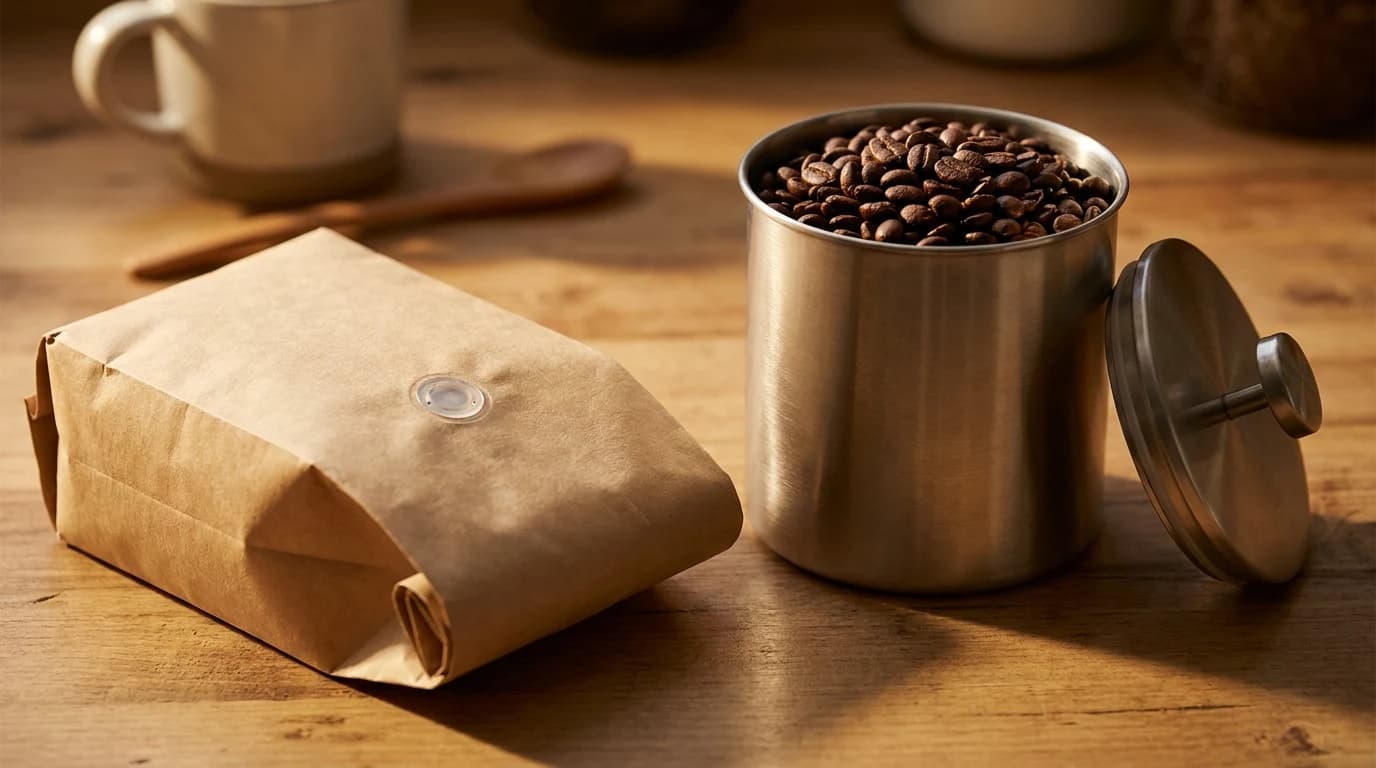
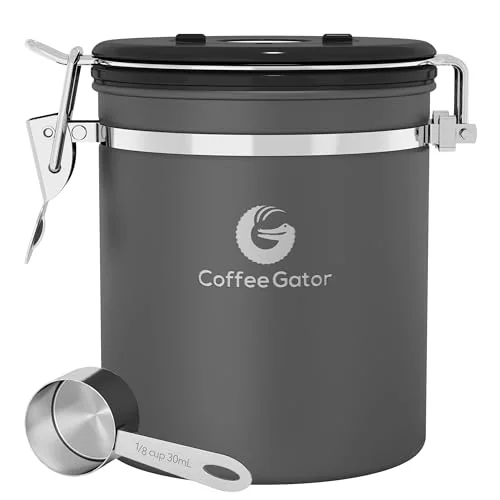
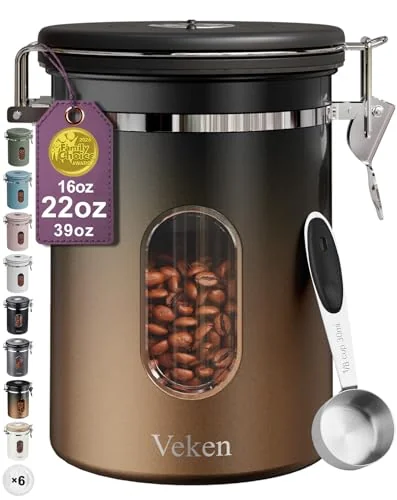
The Coffee Gator and the Veken are the two valve canisters here, and they are the cheapest, which is a happy accident rather than a compromise. Both add a date dial, which matters more than it sounds: the whole framework above depends on knowing the roast date, not the purchase date.
Plunger versus true vacuum
The Airscape's plunger pushes air out mechanically without pulling a hard vacuum, which makes it the most forgiving choice if you keep one canister for everything. A pump-style vacuum canister pulls a real vacuum and is the right tool once beans are past a month, or for pre-ground coffee, which finishes degassing far faster than whole beans; the Fellow Atmos was our pick for that until its listing changed, so the Airscape covers it here for now.
The pantry option
The OXO POP is the odd one out. It is a general pantry container with no valve and a clear body, so it wins on capacity and stacking and loses on light. Buy it for a two-pound bag in a dark cupboard, not for a display shelf.
A five-step storage routine
- Buy beans with a roast date printed on the bag, and buy what you will drink in three to four weeks.
- For the first week, leave the coffee in its original valve bag, squeeze the air out, and roll it down. This beats decanting.
- After that, move it to a canister sized so it sits nearly full, on a shelf away from the stove and the window.
- Keep it whole bean and grind per brew. Ground coffee degasses and stales dramatically faster, which is the case laid out in whole bean vs ground.
- Do not refrigerate. Cold storage is only worth it as a deep freeze for long-term stashes, covered in should you freeze coffee beans; for those stashes, vacuum sealing the beans in single-week portions keeps air off each one until you open it.
Storage buys you weeks, not months. If you want the full picture of what is actually decaying and how fast, read coffee freshness explained. A canister is a good tool for a narrow job, and knowing which job is the whole trick.
Your next step
Not sure your beans are still worth saving?
The canisters, and who each one is for
Stainless Canister with CO2 Valve
A one-way CO2 valve lets fresh beans degas without letting oxygen back in — ideal for just-roasted bags.
Coffee Canister with Window, 22 oz
A budget stainless canister with a CO2 valve, date tracker, and scoop — covers the basics for very little.
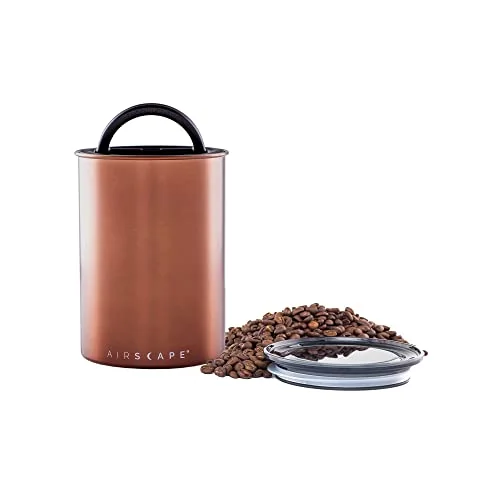
Airscape Coffee Canister
A plunger lid pushes the air out and seals with a satisfying click — simple, effective, no electronics.
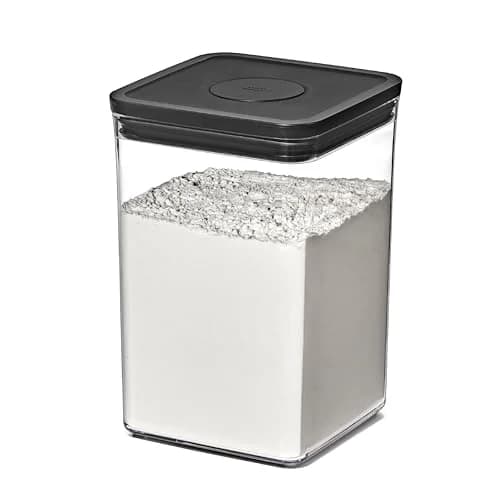
Good Grips POP Container (Big Square)
A push-button airtight lid and a stackable shape — great for storing a big bag and your whole pantry.
BrewSift earns a commission on qualifying purchases made through these links, at no extra cost to you. Prices shown were checked on publication and change often.
FAQ
Is a vacuum coffee canister actually worth it?
It depends entirely on how old your beans are. For coffee more than about a month past roast, a vacuum canister is the strongest seal you can buy at this price and it is worth the money. For beans you bought within the last week, it removes carbon dioxide the coffee produced specifically to protect itself, and lowering the pressure above the beans encourages aroma compounds to evaporate out of them. A one-way valve canister is the better choice in that window.
How long do coffee beans release CO2 after roasting?
Research from ZHAW's Coffee Excellence Center puts degassing at roughly one month for whole beans. Ground coffee is much faster because grinding shatters the porous structure holding the gas, which is one more reason to store beans whole and grind per brew.
Should I move beans out of the bag into a canister right away?
Not in the first week. A ZHAW and Tchibo study compared four ways of storing whole beans after opening a bag and found that decanting into an airtight canister performed worst of the four, behind a bag with an integrated screw cap. Every transfer swaps the CO2-rich air around the beans for ordinary room air. Squeeze the bag flat and roll it down instead, then move to a canister once the coffee has finished degassing.
What size coffee canister should I buy?
Size it so a full bag nearly fills it. Empty space is stored oxygen sitting against the beans, and it gets replenished every time you open the lid. If you buy 12 ounce bags, a 12 to 16 ounce canister is right. A 4 quart pantry container is the wrong shape for a small bag no matter how good its seal is.
Does a clear glass canister ruin coffee?
Light does degrade coffee, so a clear container on a sunny counter is a genuine downgrade compared to opaque steel. It matters far less inside a closed cupboard. Glass is otherwise an excellent oxygen barrier, so the fix is placement rather than replacing the container.
Sources
- Smrke et al. (2022), Food Packaging and Shelf Life — Effects of different coffee storage methods on coffee freshness after opening of packages
- Baxley, Clemson University thesis — Development of a User-Friendly Shelf-Life Model for Roasted and Ground Coffee Packs
- Trenzova et al. (2024), Journal of Microbiology, Biotechnology and Food Sciences — packaging type and volatile compound loss in ground roasted coffee
- Foods (2024) — Effect of Temperature and Storage on Coffee's Volatile Compound Profile and Sensory Characteristics
- Fellow — the manufacturer's own case for vacuum sealing coffee