Oxygen, light, heat, and moisture are what stale your beans. An opaque, airtight canister slows all four — but the measured evidence is narrower than the category usually admits: no container stops aroma loss, and in the first week after roast a valve beats a vacuum pump.
Quick steer — A canister earns its place once the beans outlive the bag they came in — opaque, airtight, and small enough that you finish it fast. It slows staling; it cannot reverse it.
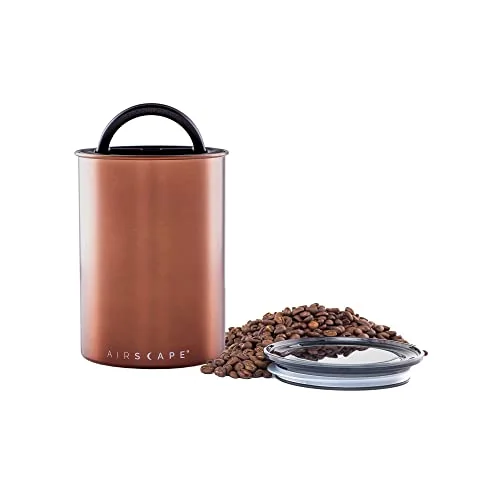
Top pick: Planetary Design Airscape Coffee Canister (8.7/10, Approx. $43.23). A plunger lid pushes the air out and seals with a satisfying click — simple, effective, no electronics.
Skip this
A canister bought to rescue coffee that is already ground
Grinding multiplies the surface area exposed to oxygen, and the aromatics go within days no matter what the coffee is sealed in. Owner threads and the National Coffee Association's storage guidance agree on the same order of operations: store whole beans airtight and opaque, and grind each dose.
The BrewSift Score is a 0–10 weighted average of category-specific sub-scores, built from manufacturer specifications, published reviews and aggregated owner reports — not hands-on testing. In this category it weights freshness seal 40%, build quality 20% and capacity 15%, plus 2 smaller factors. How we score →
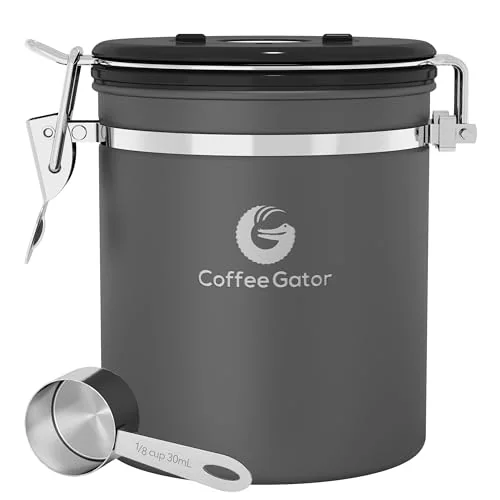
A one-way CO2 valve lets fresh beans degas without letting oxygen back in — ideal for just-roasted bags.
Coffee Gator's stainless canister is built around one feature for fresh-roasted coffee: a one-way valve that the maker says releases the CO2 beans give off while locking oxygen out. The lid carries a calendar date wheel for logging the roast or purchase date, and a measuring scoop is included. This is the medium size, sold as 16oz and listed at 0.45 litres, in BPA-free stainless steel. The valve earns its keep with freshly roasted beans that are still degassing; for older beans or pre-ground coffee, the airtight seal is what matters.
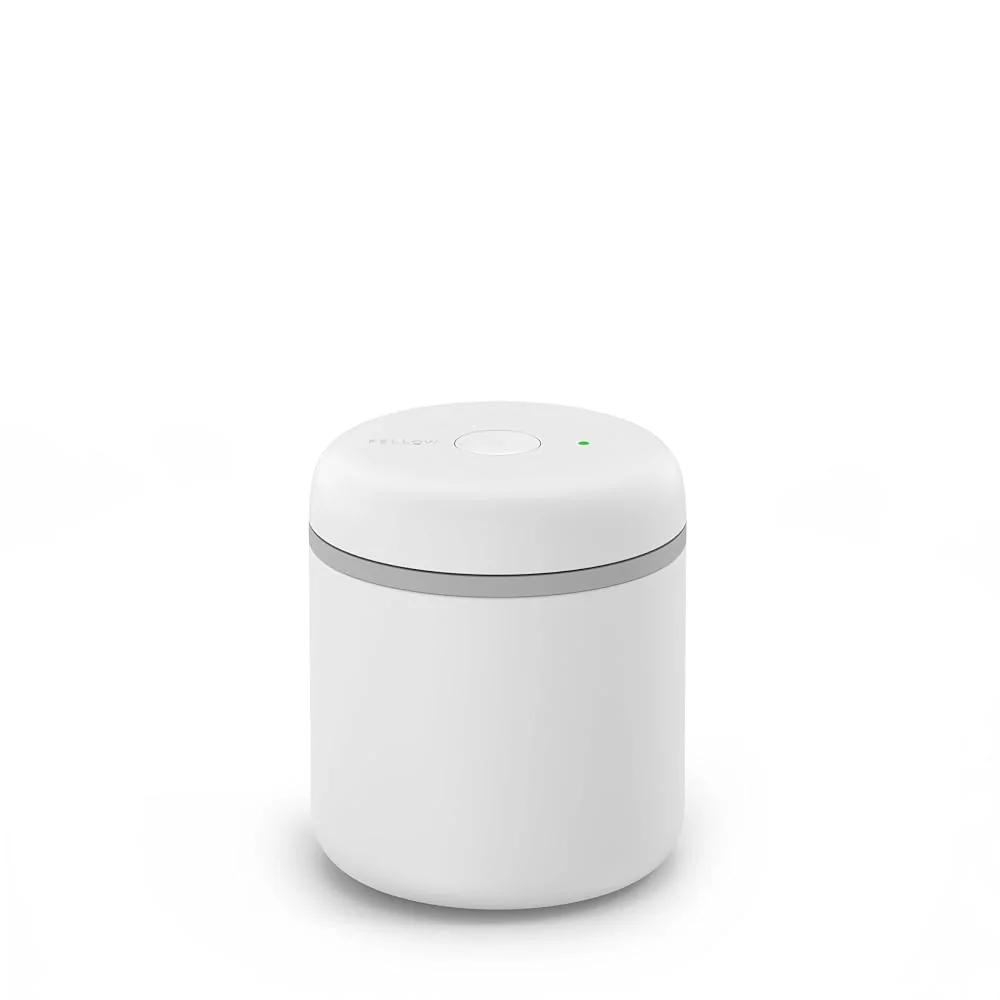
Twist the lid to vacuum out the air — the most effective (and best-looking) way to keep beans fresh.
Fellow's Atmos pulls a vacuum when you twist the lid back and forth, removing the oxygen that stales coffee, and a silicone ring holds the seal; Fellow says it keeps air out for around a week unopened. The size we link is the 0.7-liter canister, which Fellow's listing says holds 11 oz of beans, in food-safe 18/8 stainless steel. A premium design that genuinely extends bean life; if you go through more than a 12 oz bag at a time, plan on two.
Decanting a fresh bag into a canister can leave you worse off than leaving it alone. In the four-way comparison run by the ZHAW Coffee Excellence Centre with Tchibo, transferring beans into an airtight canister finished last, behind simply rolling the original bag shut with a screw cap, because the transfer exposes every bean to fresh air and dumps the CO2 blanket the bag was holding. A canister earns its place on coffee you have already opened, bought in bulk, or will keep past a couple of weeks.
What owners actually report
r/Coffeer/pouroverr/espressor/JamesHoffmann
The dominant read across r/Coffee, r/pourover, r/espresso and r/JamesHoffmann is that a canister is a convenience purchase rather than a freshness fix for anyone who finishes a 12 oz bag inside a week or two. Those threads repeatedly land on rolling the roaster's foil valve bag down and clipping it, with owners describing canisters as ritual, looks and counter tidiness rather than a taste difference they can pick out; James Hoffmann's canister comparison gets cited in almost every one of them as having reached the same conclusion. The picture flips for people buying in bulk or opening the same bag daily, where the recurring advice is a plunger or vacuum canister sized to roughly two weeks of coffee. Inside that group the Airscape is recommended far more often than the twist-pump alternatives, and a sizeable minority skips canisters entirely in favour of vacuum-sealed bags portioned out of a kilo.
Consistently praised
Airscape plunger canisters — Chosen over pricier vacuum canisters again and again because the plunger lid has no pump or motor to fail, the canisters stack, and owners report the seal still working years in.
The roaster's own foil valve bag — Threads that open as canister recommendations often close with owners saying a foil bag with a one-way valve, rolled down and clipped, keeps a fast-moving bag fresh enough that they cannot taste the difference.
Vacuum-sealed bag systems — The recurring answer from people buying a kilo at a time: portion the beans into vacuum bags and pump the air out, so the working supply is the only coffee ever exposed to air.
Consistently warned about
Twist-pump vacuum lids — The single most repeated complaint in these threads is losing vacuum within a day or two and the twisting becoming a chore; several owners describe replacing lids or moving to a plunger design instead.
Clear jars kept on the counter — Light is one of the four things a canister exists to block, so a glass jar in daylight undoes part of the point; the compromise owners settle on is glass in a cupboard, or only a few days of beans at a time.
Oversizing the canister — A canister kept half empty is mostly headroom, which is the air you were trying to remove; the advice that recurs is buying a size you empty in two to three weeks rather than one that fits your biggest ever order.
The five canisters BrewSift ranks run $22 to $44, a 2x spread for a job all five do with the same four levers: an airtight seal, opacity, headspace control, and some way of dealing with CO2.
Oxygen is the enemy — but decanting has a cost
Oxygen oxidizes the aromatic oils that carry flavor, so keeping air away from beans is the whole job. Vacuum canisters pump the air out; valve canisters use a one-way CO2 valve that lets freshly-roasted beans push their own gas out without letting fresh air back in. Where the category usually overclaims is the comparison against the bag: in a four-way test by the ZHAW Coffee Excellence Centre with Tchibo, decanting into an airtight canister performed WORST — behind simply rolling the original bag shut with a screw cap — because the transfer itself exposes every bean to a fresh lungful of air and dumps the CO2 blanket the bag was holding. The practical read: a canister earns its place for beans you have already opened, bought in bulk, or will keep past a couple of weeks. For a fresh valve bag you will finish quickly, leave it in the bag.
Keep it opaque and away from heat
Light and heat accelerate staling alongside oxygen. UV breaks down the oils and warmth speeds every reaction, so an opaque canister stored in a cool cupboard away from the stove and window does most of the protective work on its own. The worst case is a clear glass jar on a sunny counter above the range — pretty, but it bakes and bleaches your beans. If you love a glass display jar, keep it out of direct light and only fill it with a few days' worth.
Vacuum vs valve — pick for your habit
Valve canisters are the simplest: drop beans in, the one-way valve vents CO2, and you never think about it — ideal for very fresh, recently-roasted beans that are still off-gassing. Plunger and vacuum canisters actively remove air each time you close them: the Airscape pushes an inner lid down onto the beans, and twist-pump designs such as the Fellow Atmos draw the air out through the lid. That protects beans that have finished degassing and suits people who open the canister daily. If you buy fresh single-origin often, a valve, plunger or vacuum container all work; for beans a week or two past roast, removing the headspace air has the edge.
Size it to how fast you drink
A canister only helps if the beans inside get used before they'd stale anyway, and a big canister kept half-empty is mostly air — the thing you're trying to remove. Buy a size you'll empty in two to three weeks, and if you buy in bulk, keep the working supply in a right-sized canister and the rest sealed elsewhere (or frozen in portions). Right-sizing matters more than most people expect, because headroom is trapped oxygen.
The freshness window a canister is buying you
Storage buys time, it does not stop the clock — so it helps to know the clock. Whole beans hit their stride a few days off the roast date once they finish releasing CO2, hold a genuine peak for two to three weeks in a good airtight, opaque canister, and then fade gradually rather than spoiling. Ground coffee runs on a far shorter fuse: it loses its brightest aromatics within minutes and is best used within a week or two even sealed. The freshness calculator below turns your roast date and storage method into exactly where you sit on that curve, so you can tell 'past its peak but fine' from 'genuinely stale' instead of guessing. The practical takeaway: a canister is worth most for whole beans you grind on demand, and no container rescues pre-ground coffee for long.
Whole beans, and grind on demand
No canister saves pre-ground coffee for long — grinding multiplies the surface area exposed to air, so ground coffee goes flat in days no matter how you store it. The highest-leverage storage move is to store whole beans in a good canister and grind each dose fresh. If you must store ground coffee, keep it in the most airtight container you have and use it fast; the canister buys days for beans but only hours to a couple of days for grounds.
What vacuum-sealed actually means on a coffee container
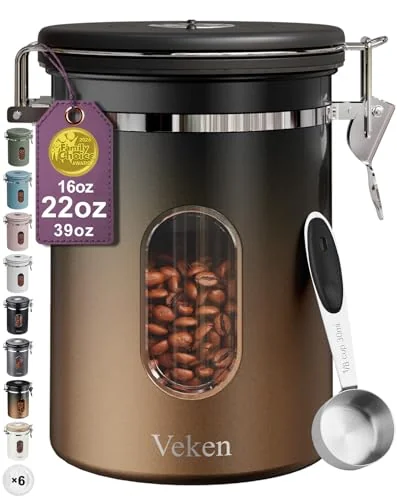
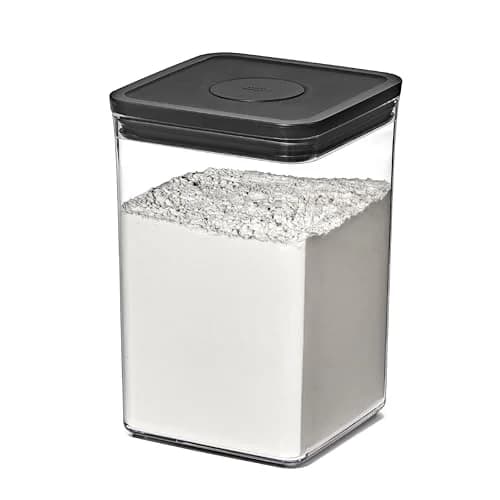
A vacuum coffee container almost never pulls a laboratory vacuum. What a vacuum-sealed coffee storage container actually does is remove most of the headspace air above the beans, and that is enough, because staling tracks how much oxygen sits against the beans rather than the last few percent of it. Four seal designs are sold under overlapping labels, and they work differently. A twist-lid vacuum such as the Fellow Atmos has a small pump built into the lid, so every close actively draws air out. A plunger canister such as the Airscape pushes an inner lid down onto the beans and forces the air out through a valve in the plunger before the outer cap goes on, which is why Planetary Design sells it as removing excess oxygen rather than as a true vacuum. A one-way CO2 valve, as on the Coffee Gator and Veken canisters, never removes air at all: the valve lets gas from degassing beans escape and blocks outside air from coming back in. A plain airtight coffee container, like OXO's push-button POP container, stops the exchange without touching the air already sealed inside. Ranked by how little oxygen ends up against the beans, active vacuum beats plunger, plunger beats valve, and valve beats plain airtight. Ranked by effort per use, that order reverses exactly. That trade between oxygen removed and effort per use, not the marketing word on the box, is the real decision when choosing a coffee storage container.
Storing ground coffee: what changes
If you are shopping for a container specifically for pre-ground coffee, three things change. First, a CO2 valve buys you much less. Most of the degassing happens in the days after roasting and grinding accelerates what is left, so by the time a bag of ground coffee reaches you the pressure-venting job a valve exists to do is largely finished. What still matters is that nothing gets back in, which is the airtight half of the equation. Second, grounds settle far denser than whole beans, so the same weight of coffee occupies noticeably less space. Buy smaller than you would for beans, or you will be sealing in a container that is mostly headroom. Third, ergonomics matter more than they do with beans, because you scoop grounds rather than pour them. A wide opening you can get a spoon into without spilling, and a lid you can work one-handed at 6am, will affect your experience more than a few points of seal performance. Be honest about the ceiling, though. A good container slows ground coffee down; it does not preserve it the way it preserves beans. The aromatics that make coffee smell like coffee are gone within days of grinding no matter what you seal them in, so buy ground coffee in amounts you will finish in a week or two and treat the container as damage control rather than a fix.
When the roaster's bag is good enough
A specialty roaster's foil valve bag is good enough coffee storage for a bag you will finish within about a week. That bag is usually foil-lined, so it blocks light completely, it carries a one-way degassing valve, and until the first opening the coffee inside is effectively sealed at the roastery. For a one-week bag, rolling the top down tightly to squeeze out the air and clipping it shut is a reasonable way to store coffee, and decanting into a coffee container gains very little while throwing away the roast date printed on the bag. In the four-way ZHAW Coffee Excellence Centre comparison with Tchibo, rolling the original bag shut beat decanting into an airtight canister. The roaster's bag stops being good enough in three situations. A bag opened daily admits a fresh charge of air at every opening that the bag cannot expel again, so by week two the beans sit in a floppy pouch of oxygen. A bulk bag opened repeatedly is the worst case of all. And supermarket coffee sold in a paper or thin plastic bag with no valve and no foil layer was never protected in the first place. The rule of thumb: keep the roaster's bag for a week's worth of coffee, and move to a proper coffee storage container once the bag will be opened more than a handful of times.
Materials, gaskets, and keeping the container from tainting the coffee
Stainless steel is the default material for a coffee storage container because steel is opaque, holds no odors, and survives being knocked off a counter. Glass coffee containers look better on a countertop and are easy to inspect, but glass lets light in, so a glass jar belongs in a cupboard or should hold only a few days of beans at a time. Food-safe plastic is light, cheap and often stackable; clear plastic shares the light problem of glass, and opaque plastic can pick up odors over years of use. Whatever the body is made of, the silicone gasket is the part of a coffee container that fails first. Coffee beans are oily, those oils go rancid, and a silicone gasket holds onto old rancid oil and passes that flavor to the next bag. To keep a canister from tainting fresh coffee, pull the gasket out and wash it, wipe the lid threads and any valve housing, and dry every part completely before refilling, because trapped moisture does more harm than a little oil residue. Check the manufacturer's manual before putting a lid in the dishwasher: pump and valve mechanisms are frequently hand-wash only, and a warped or swollen gasket quietly turns an airtight coffee container into a decorative one. A canister that seals perfectly but smells of last month's dark roast is not doing its job.
Reading capacity claims before you buy
Capacity is the most confusingly labelled spec in this category, because manufacturers quote two incompatible things. Some give volume, in liters, quarts, or fluid ounces. Others give the weight of coffee the container holds, in ounces or pounds. These are not interchangeable, and you cannot convert between them in your head, because whole roasted beans are far less dense than water. A container listed at 64 fluid ounces and one listed as holding a pound of beans are describing the same problem from opposite directions. Ground coffee packs denser still, so a container sized for a pound of beans holds meaningfully more than a pound of grounds. Before comparing two products, work out which unit each one is using and convert to the number you actually care about: how many bags of your usual coffee it swallows. Then think about what happens as the container empties. A fixed airtight container has more and more trapped air in it as you work through a bag, so it protects the last quarter worst. A plunger or vacuum design compensates, because the seal follows the coffee level down rather than sitting above a growing pocket of air. If you tend to run a container down to the bottom before refilling, that difference matters more than a slightly larger nominal capacity.
Airtight coffee bags and vacuum bags, versus a canister
Bags are a genuine alternative to a canister rather than a lesser one, and for bulk buying they are usually the better answer. The logic is portioning. A canister protects whatever is inside it, but you keep opening it, so the whole supply meets fresh air every morning. Splitting a large order into weekly bags and sealing them means only the portion you are drinking is ever exposed, and the rest sits untouched until its turn. What to look for in a storage bag is what a good roaster's bag already has: an opaque foil laminate rather than clear plastic, since light is one of the things you are guarding against, and a one-way degassing valve if the coffee is freshly roasted and still releasing carbon dioxide. A zip closure is worth having for a bag you open repeatedly; heat-sealed or vacuum-sealed bags are for the portions you are storing rather than using. The compromise most people end up with is both, and it is the sensible one: bags or the roaster's own bag for the reserve, and a canister on the counter holding only the week's working supply.
Not the fridge: it is humid and the beans absorb odours. The freezer works for beans you will not open for weeks: portion them into airtight single-use amounts, take out only what you need and grind it straight from frozen, and never thaw and refreeze the same portion.
Do I need a vacuum canister or is airtight enough?
Airtight and opaque is the minimum and covers most people. A vacuum or one-way-valve canister matters for beans you keep more than two weeks: fresh beans give off carbon dioxide that an airtight tin traps, while a valve vents it and keeps oxygen out.
Do coffee canisters really keep beans fresh?
Yes — a good airtight, opaque canister meaningfully slows staling by cutting off the oxygen, light, and (with a valve or vacuum) trapped air that degrade coffee. It won't make old beans fresh again or freeze time, but it stretches a bag's peak window from a few days to a couple of weeks versus a repeatedly-opened clip-bag. It's one of the cheapest ways to protect coffee you've already paid a premium for; the return is real, if not magical.
Should you freeze coffee beans?
For long-term storage, yes — freezing genuinely preserves coffee if you do it right. Portion beans into truly airtight, single-use amounts, freeze them, and take out only what you'll use, grinding straight from frozen without letting the bag thaw and refreeze. The enemy is moisture and condensation from repeated temperature swings, so never refreeze a portion you've opened. For beans you'll finish within two to three weeks, a room-temperature canister is simpler and just as good.
Vacuum vs valve canister — which is better?
It depends on how fresh your beans are and how often you open the canister. A valve canister lets freshly-roasted beans vent CO2 while blocking incoming air, so it's ideal for very fresh coffee and requires zero effort. A vacuum canister actively pulls air out each time you seal it, which better protects beans that have finished degassing and people who open it daily. For most home drinkers either works well; buy vacuum if you often keep beans past a couple of weeks.
Can you store coffee in the fridge?
It's best avoided. A fridge is humid and full of strong odors, and coffee's oils readily absorb both moisture and food smells, so beans can pick up off-flavors and pull in dampness that dulls them. The temperature swings each time you open the door also invite condensation. If you want cold storage for the long haul, the freezer — in airtight, single-use portions — is the right tool; for everyday beans, a cool, dark cupboard in a good canister beats the fridge.
How long do coffee beans stay fresh?
Whole beans are at their best roughly one to three weeks after the roast date, then decline gradually over the following weeks — they're rarely unsafe, just flatter and less aromatic. Ground coffee fades far faster, losing much of its character within days of grinding. Buy by roast date rather than a distant best-by, store whole beans airtight and opaque, and grind each dose fresh; that sequence keeps coffee tasting close to its peak for as long as possible.
What is the best coffee storage container?
For most people it is an opaque, genuinely airtight coffee container sized to about two weeks of coffee, with a plunger or vacuum seal if you open it daily. Our top pick is the Airscape, whose inner plunger lid pushes the air out above the beans with no pump or electronics; the medium size holds about a pound of whole beans, per Planetary Design. If you buy very freshly roasted beans, a one-way CO2 valve canister like the Coffee Gator lets them degas for about half the price. The Fellow Atmos pulls a true twist-lid vacuum; the 0.7-liter size we link holds about 11 oz of beans, per Fellow's listing, a little under a standard 12 oz bag. For a bag that gets opened every morning for two weeks or more, any of the live picks beats a clipped bag.
Is there a difference between a coffee canister and a coffee storage container?
No, the words describe the same product. Canister is the older, more traditional term and tends to be used for the cylindrical stainless steel style; container is the broader everyday word and covers square, stackable, and plastic designs too. Retailers and roasters use both interchangeably, so searching for one and not the other means missing half the market. What actually matters is not the noun on the label but three physical properties: whether it is truly airtight, whether it is opaque, and what the seal does with the air already inside, which is where vacuum, plunger, valve, and plain airtight designs genuinely differ.
Are vacuum coffee containers worth it?
They are worth it if you open your coffee every day or keep beans past a couple of weeks, and largely wasted if you finish a bag in five days. A vacuum container removes the air you let in each time you open it, which is exactly the exposure that flattens coffee over a two- to three-week bag. If your beans never sit that long, a simple airtight container captures most of the benefit for less money and less fiddling. Be realistic about the extra step, too: a vacuum design only works if you actually pump or plunge it every single time, and a twist you skip protects nothing.
What is the best container for ground coffee?
A small, opaque, airtight container with a wide opening you can scoop from. Ground coffee no longer needs a CO2 valve, since most degassing is over by the time you buy it, so prioritize a tight seal and a size you will empty quickly instead. Grounds pack denser than whole beans, so buy smaller than seems right or you will seal in a large pocket of air. The honest caveat is that no container preserves ground coffee for long. Grinding multiplies the surface area exposed to oxygen and the aromatics fade within days, so buy in small amounts and use them fast.
Can you store coffee in a mason jar?
You can, and a sealed mason jar is better than a folded bag, but it has two real weaknesses. It is clear, so light reaches the beans unless you keep the jar in a dark cupboard, and it does nothing about the air already inside, which grows as a pocket every time you take coffee out. That makes it decent short-term storage for beans you will finish in a week or two, kept out of the light, and a poor choice for a countertop display. If you like the look of glass, a purpose-built container with a plunger or vacuum lid solves the trapped-air half of the problem that a plain jar cannot.
Are airtight coffee bags good enough, or do I need a canister?
For coffee bought in bulk, bags are often the better tool. A canister protects what is inside it but gets opened every morning, so the entire supply meets air daily; portioning into sealed bags means only the week you are drinking is ever exposed. Look for the same features a good roaster's bag has: an opaque foil laminate rather than clear plastic, a one-way valve if the coffee is freshly roasted, and a zip only on the bag you are actively using. The setup most people settle on uses both, with bags or the original bag holding the reserve and a canister on the counter holding the working supply.