How Long Caffeine Actually Lasts (And When to Stop Drinking Coffee)
Caffeine typically starts working in about 30 minutes and has a half-life of roughly five to six hours, so a meaningful fraction of an afternoon cup is still in your body at bedtime even after the alert feeling has gone. There is no universal cutoff hour — work backward from the time you actually intend to sleep, and account for the size of the dose, not just the number of cups.
Key takeaways
- Half-life is not an expiry time — it is the point at which half the amount is still present.
- The feeling wearing off is not evidence that the caffeine has cleared.
- Dose and timing work together, so a large serving needs an earlier cutoff than a small one.
- Earlier cups still count, because multiple servings overlap rather than reset.
- Night workers should plan around their intended daytime sleep block, not the clock.
The feeling fades before the substance does. "How long does caffeine last" rarely means when the lift ends — it means how much is left at bedtime.
The half-life is a starting point, not a personal stopwatch
- ~30 min Typical time for caffeine to produce an effect, per NIOSH.
- 15–45 min The range NIOSH gives around that onset.
- 5–6 hours Typical half-life: the time for the amount in your body to fall by half.
Source: CDC/NIOSH, Sleep Aids and Stimulants: Caffeine.
Half-life is not an expiry time. It is the point at which half the amount is still present — not when caffeine has cleared, when its effect has stopped, or when sleep is unaffected. As an illustration only, 200 milligrams at 2 p.m. on an exactly five-hour half-life leaves about 100 milligrams at 7 p.m., 50 at midnight, 25 at 5 a.m.
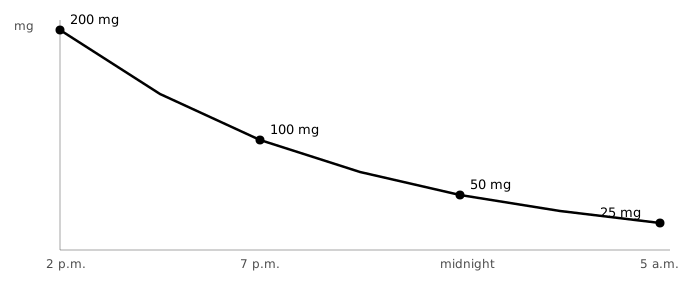
Illustrative only. Remaining milligrams do not convert into minutes of lost sleep.
A large serving and a small one therefore cannot share a cutoff: after the same number of half-lives, the larger dose leaves more behind.
Count the dose, not just the cups
"A coffee" is a poor unit. The FDA emphasizes that caffeine content and serving sizes vary, that caffeine appears in foods and medicines too, and that decaf still contains some. Its 400-milligram daily figure is not generally associated with negative effects in most adults — it is not a sleep-friendly target. Run what you actually drink through our caffeine by brew method calculator.
Audit a few representative days — it is usually the oversized first cup that matters
- Write down the actual drink, not the category — the café order or exact home brew.
- Record the serving size, including the mug you use, not the one on the box.
- Note the best available caffeine estimate, or a range when unsure.
- Count the second mug topped up during meetings, plus afternoon tea and any caffeinated workout drink.
What the sleep experiments actually tell us
In 2013, Christopher Drake and colleagues tested 400 milligrams at bedtime, three hours before, or six hours before; sleep was disrupted even at six hours. A randomized crossover trial by Carissa Gardiner and colleagues later gave 23 men 100 or 400 milligrams at various intervals: the higher dose affected sleep well before bedtime, while the 100-milligram conditions showed no significant differences in that sample.
Participants did not always accurately perceive the effects measured during sleep.
Both were small studies, so neither settles anything for pregnant people, older adults, people with insomnia or unusually sensitive sleepers — and no significant effect in one experiment is not proof of no effect for you. What they support is a better rule than a fixed hour: dose and timing work together.
Work backward from the sleep you actually intend to get
Start from the hour you expect to try sleeping, not the hour you hope to leave work. Someone aiming for 10 p.m. has a different window from someone aiming for midnight — and a night worker sleeping at 9 a.m., different again.
Run it as one experiment, not five — this is a test, not a medical rule
- Fix the target — the hour you intend to be asleep, not the hour you hope to finish work.
- Pick one change: move the final caffeine earlier, or drop the afternoon serving. Not both.
- Hold it for several comparable days, so you read a pattern rather than one night.
- Keep everything else steady — bedtime, alcohol, the usual evening routine.
- Read the result, then decide whether a second adjustment is worth trying.
The last cup is not the only cup that matters
Servings overlap rather than reset: stopping early does not erase earlier doses.
- ~100 mg What a 200 mg dose at 9 a.m. leaves by 2 p.m.
- ~300 mg The modeled amount once a second 200 mg dose is added at 2 p.m.
- ~150 mg That combined amount five hours after the second dose.
Source: Illustrative calculation on a simplified five-hour half-life. Not a personalized prediction.
So the first adjustment is usually serving size, not banning a ritual: a smaller mug, a weaker second cup, one refill swapped for something noncaffeinated.
Lower-caffeine swaps that keep the ritual
If the drink to change is the second or third, the question is what goes in the mug instead. These fit the methods you already use, so the break does not change — and per the FDA, the distinction is lower caffeine, not zero. Our best decaf coffee guide covers the whole-bean side.
| Option | Format | About | Why pick it |
|---|---|---|---|
| Volcanica Colombian Decaf (Swiss Water) | Whole bean | $31.99 | Swiss Water process named on the product. Needs a grinder. |
| Peet's Decaf Major Dickason's Blend Ground, 10.5 oz | Ground, dark roast | $9.98 | No grinder, and a dark roast survives a drip machine. Stales faster. |
| Green Mountain Half Caff, 48 ct | K-Cup pods | $27.94 | Reduces the dose instead of removing it, which suits a taper. |
| Keurig Decaf Variety Pack, 24 ct | K-Cup pods | $15.78 | Smallest commitment, and a variety box finds a decaf you will drink. |
| Nespresso Arpeggio Decaffeinato, 50 ct | Nespresso Original capsules | $47.50 | Keeps the espresso ritual after the cutoff. Original line only. |
Prices are approximate and may vary. Please check the latest price on Amazon.
"I can fall asleep after coffee" is incomplete evidence
Falling asleep is one outcome among several, and the Gardiner trial's gap between measured and perceived sleep is a reason not to trust the feeling that coffee does nothing.
Worth tracking
- Whether the night felt continuous or broken
- Whether you woke earlier than you intended
- How much caffeine you need to feel functional again
- Repeatable changes across several comparable days
Not enough on its own
- How fast you fell asleep
- How you felt about one particular night
- A single bad night after a stressful day
- A single good night after a late drink
None of this diagnoses a sleep disorder; a note each morning is enough.
Night shifts reverse the clock, not the principle
For overnight work, "no coffee after lunch" is meaningless. What matters is the intended daytime sleep block, and NIOSH warns that end-of-shift caffeine can interfere with sleep the following morning. Place the decision inside a realistic night-shift sleep schedule, not a separate productivity trick.
Keeping that last stretch caffeine-free is planning, not a guarantee of alertness. Dangerous fatigue calls for a safer transport plan; more coffee is not permission to drive when you are struggling to stay awake.
Make the change without making the week miserable
The FDA advises reducing habitual caffeine gradually, because withdrawal can be unpleasant. Replace part of a serving, cut a daily refill, or move to a smaller cup before changing the timing.
The lowest-friction version is a jar. Mount Hagen Organic Freeze Dried Instant Decaf, 3.53 oz, about $14.99, turns the 4 p.m. refill into a one-spoon decision needing no brewer and no grinder. It still contains some caffeine and will not taste like your pourover — but the point of that cup was never flavor.
Coffee timing cannot repair every sleep problem
An earlier cutoff does not create more hours in the day. The National Heart, Lung, and Blood Institute recommends protecting adequate sleep time and sleep-supportive habits, including caffeine and the sleep environment.
Check the constraints before blaming the coffee
- Are you getting into bed late because chores start only after everyone else sleeps?
- Is your room noisy, bright, or otherwise working against you?
- Does your schedule change sharply between workdays and days off?
- Are you protecting enough hours to sleep in, or only enough to lie down in?
Removing a late coffee cannot fix an impossible timetable. Persistent insomnia, marked daytime sleepiness or symptoms that worry you deserve professional assessment, and pregnancy, breastfeeding, medications and health conditions all change which caffeine choices are appropriate — ask a clinician, not a coffee article.
The useful takeaway
Work backward from your actual bedtime, count the whole pattern rather than the last cup, and test one change. This is not an argument for quitting coffee, only for being deliberate about how much and how late. Every dose-decay figure above is illustrative, not a measured outcome.
What this post actually asks you to buy, if anything
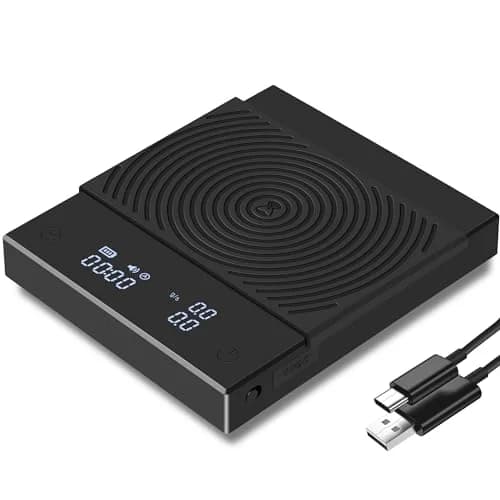
Black Mirror Basic 2
Acaia-style 0.1g performance and a fast refresh for less than half the price.

Keurig Decaf Variety Pack, 24 ct
A decaf sampler across roasts — 24 pods at about 66 cents — for finding a decaf you'll actually drink.
BrewSift earns a commission on qualifying purchases made through these links, at no extra cost to you. Prices shown were checked on publication and change often.
FAQ
How long does caffeine actually last?
NIOSH describes caffeine as taking about 30 minutes to produce an effect, within a range of roughly 15 to 45 minutes, and gives a typical half-life of five to six hours. Half-life is the time for the amount in your body to fall by half, so it marks a gradual decline rather than a point at which caffeine has cleared.
What time should I stop drinking coffee?
There is no universal cutoff hour. The useful approach is to work backward from the time you actually intend to be asleep and to account for the size of the dose as well as the timing, because a large serving and a small serving do not deserve the same cutoff.
If I can fall asleep after an evening coffee, does that mean it is fine?
Not necessarily. Falling asleep is only one outcome. In the Gardiner crossover trial, participants did not always accurately perceive the effects that were measured during their sleep, so how quickly you drift off is incomplete evidence on its own.
Does drinking water flush caffeine out faster?
Drinking normally can address thirst, but there is no proven shortcut here that rapidly clears caffeine. Plan around the dose you have already consumed rather than treating an extra glass of water as a cancellation.
Is switching to decaf actually worth it?
It can be. A lower-caffeine substitution can preserve a routine you value while changing your exposure. The FDA notes that decaffeinated coffee still contains some caffeine, so the honest distinction is lower caffeine versus zero caffeine.
I work night shifts. Does the same advice apply?
The principle applies but the clock reverses. What matters is your intended daytime sleep block, so a coffee at the end of an overnight shift can sit close to bedtime even in daylight. NIOSH specifically warns that end-of-shift caffeine can interfere with sleep the following morning.
Sources
- CDC/NIOSH — Sleep Aids and Stimulants: Caffeine (onset, typical half-life, end-of-night-shift caution)
- FDA — Spilling the Beans: How Much Caffeine is Too Much? (variable serving content, decaf, gradual reduction)
- Drake C, et al. — Caffeine Effects on Sleep Taken 0, 3, or 6 Hours before Going to Bed (J Clin Sleep Med, 2013)
- Gardiner CL, et al. — Dose and timing effects of caffeine on subsequent sleep: a randomized clinical crossover trial (Sleep, 2025)
- NHLBI — Healthy Sleep Habits (protecting sleep time and the sleep environment)