Philips 3200 vs 2200 LatteGo
Short answer: Buy the 2200 unless you want one-touch Americanos and latte macchiatos, because those two drink buttons are essentially the whole of the 3200's premium. Philips's spec sheets list the same hardware on both: a 12-step ceramic grinder, a 1.8 L tank, a 275 g bean hopper, the two-part LatteGo milk carafe, a removable brew group and a touch display. Also worth knowing: Philips's US support page lists the 3200's EP3241/54 as discontinued, though Amazon still sells it.
Updated
Part of our guide to the best automatic espresso machines (super-automatic).
Head to headHighest overall score: Philips 3200 Series LatteGo (8.3 vs 7.9) — but pick by how you brew.
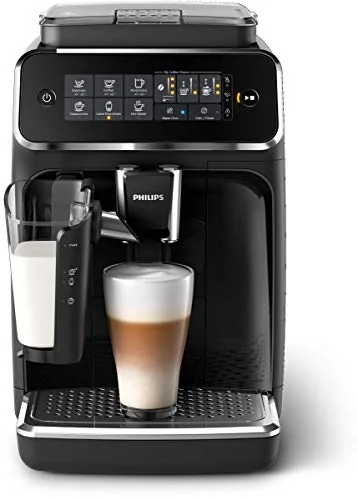 | 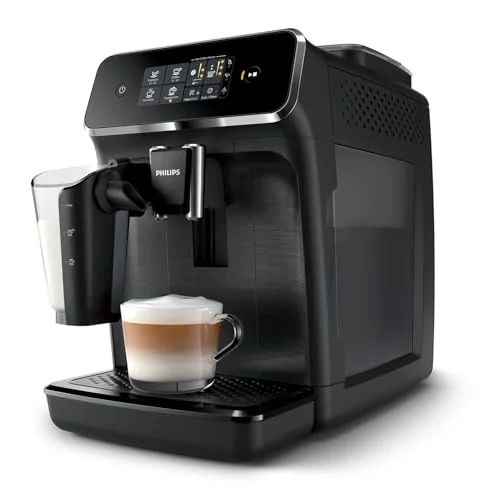 | |
|---|---|---|
| Score | 8.3/ 10 Higher | 7.9/ 10 |
| Price | $500.04approx.Checked 2026-10-09 | $399.99approx. |
| Get it for | most one-touch drinks, latte macchiato at a touch | lowest price for a one-touch cappuccino, buying the current model |
| Drinks | 5 one-touch | 3 one-touch (espresso, coffee, cappuccino) |
| Grinder | Ceramic burr, 12 settings | Ceramic burr, 12 settings |
| Milk | LatteGo (no tubes) | LatteGo (no tubes) |
| Brew group | Removable | Removable |
| AmazonFull review of Philips 3200 Series LatteGo | AmazonFull review of Philips 2200 Series LatteGo |
Prices are approximate; use the listing for the current offer.
What the extra money buys — The 3200 costs substantially more than the 2200. That buys two more one-touch drinks, Americano and latte macchiato, and a LatteGo storage lid in the box. It does not buy better hardware: Philips's spec sheets list the same ceramic grinder, 1.8 L tank, 275 g hopper, LatteGo milk system and touch display on both, and the 3200's EP3241/54 is now listed as discontinued on Philips's US support page.
Approximate — verify the latest price
BrewSift earns a commission on some purchases. It never changes our scores. Why you can trust us
Approximate — verify the latest price
BrewSift earns a commission on some purchases. It never changes our scores. Why you can trust us
Philips 3200 vs 2200 LatteGo: which wins for you
Philips lists five one-touch coffees on the 3200 — espresso, coffee, Americano, cappuccino and latte macchiato — against three on the 2200. It scores 80 for drink variety here against 70.
The same grinder, tank, bean hopper, LatteGo carafe and removable brew group on Philips's spec sheets, for substantially less.
Latte macchiato is one of the 3200's presets. On the 2200 you build it by hand from a cappuccino or espresso and extra milk.
Philips's US support page lists the 3200's EP3241/54 as discontinued; the 2200's EP2230/14 carries no such flag.
Philips 3200 vs 2200 LatteGo: score by dimension
BrewSift sub-scores for super-auto. The longer bar wins each row; equal scores are both highlighted.
Philips 3200 vs 2200 LatteGo: specs side by side
Philips 3200 vs 2200 LatteGo: the bottom line
Buy the 2200 unless you want one-touch Americanos and latte macchiatos, because those two drink buttons are essentially the whole of the 3200's premium. If you just want the stronger all-rounder, the Philips 3200 Series LatteGo edges it on our overall score (8.3 vs 7.9).
More comparisons in super-automatic espresso machines
Other matchups we have run side by side, same scoring, same spec sheet.
Common questions
Philips 3200 vs 2200: what is the actual difference?
The drink menu. Philips's spec sheets list the 3200 with five one-touch coffees — espresso, coffee, Americano, cappuccino and latte macchiato — plus hot water, and the 2200 with three — espresso, coffee and cappuccino — plus hot water. The hardware behind them is listed the same: a 12-step ceramic grinder, three aroma-strength settings, three temperature settings, a 1.8 L tank, a 275 g bean hopper, a 15-bar pump, the 0.26 L LatteGo milk carafe and a touch display. The 3200 also ships with a LatteGo storage lid.
Is the Philips 3200 worth the extra money over the 2200?
Only if you will press the Americano or latte macchiato button often. Everything else that shapes daily use — the grinder, the milk system, the tank and hopper sizes, the removable brew group — is the same on Philips's spec sheets. If your drinks are espresso, coffee and cappuccino, the 2200 does all three for less, and a latte macchiato is easy to make by hand from its cappuccino.
Do the 3200 and 2200 make the same espresso?
Very close. Both use the same 100% ceramic grinder, which Philips rates for at least 20,000 cups, the same 15-bar pump, and Philips's Aroma Extract system, which it says keeps brewing water between 90 and 98°C. The 3200 scores 78 for drink quality here against the 2200's 74, but neither is the reason to pick one over the other, and neither matches a good manual machine for shot quality — the trade-off for one-touch convenience.
Is the Philips 3200 LatteGo discontinued?
Philips's US support page lists the 3200 LatteGo EP3241/54, the model this page links, as discontinued, and Philips's US product page for it now points to a newer 3200 LatteGo model with an iced coffee option. Amazon still sells the EP3241/54. Discontinued does not mean unsupported — Philips still publishes support material and lists accessories for it — but it does make the current 2200 the more future-proof choice if the drink menu does not matter to you.
Does the 2200 have a touch display?
Yes. Philips lists a touch display on both the 2200 and the 3200, so the interface is not a difference between them. What the 3200 adds on that display is two more drink buttons.
How easy are they to clean?
Equally easy. Both use the LatteGo carafe, which Philips describes as two parts with no tubes that can be rinsed in about 15 seconds or put in the dishwasher, and both have a fully removable brew group for easy cleaning. Both take Philips's AquaClean filter, which Philips says lets you go up to 5,000 cups without descaling when you change the filter as prompted.
Can you use pre-ground coffee in them?
Yes. Philips lists a coffee powder option on both machines, so you can brew from pre-ground coffee — handy for an occasional decaf without emptying the bean hopper.
Philips 3200 Series LatteGo
$500.04