Do You Actually Need a Coffee Scale? An Honest Answer
It depends on how you brew. For espresso and pour-over, where the brew is fast and a single gram of dose swings the ratio, a scale is close to essential for repeatable coffee. For French press and cold brew, a long steep and a wide ratio window absorb small errors, so a scale helps but is not transformative. A scale's real job is not precision for its own sake; it removes the invisible day-to-day drift a scoop introduces, because one scoop can weigh anywhere from 8 to 14 grams.
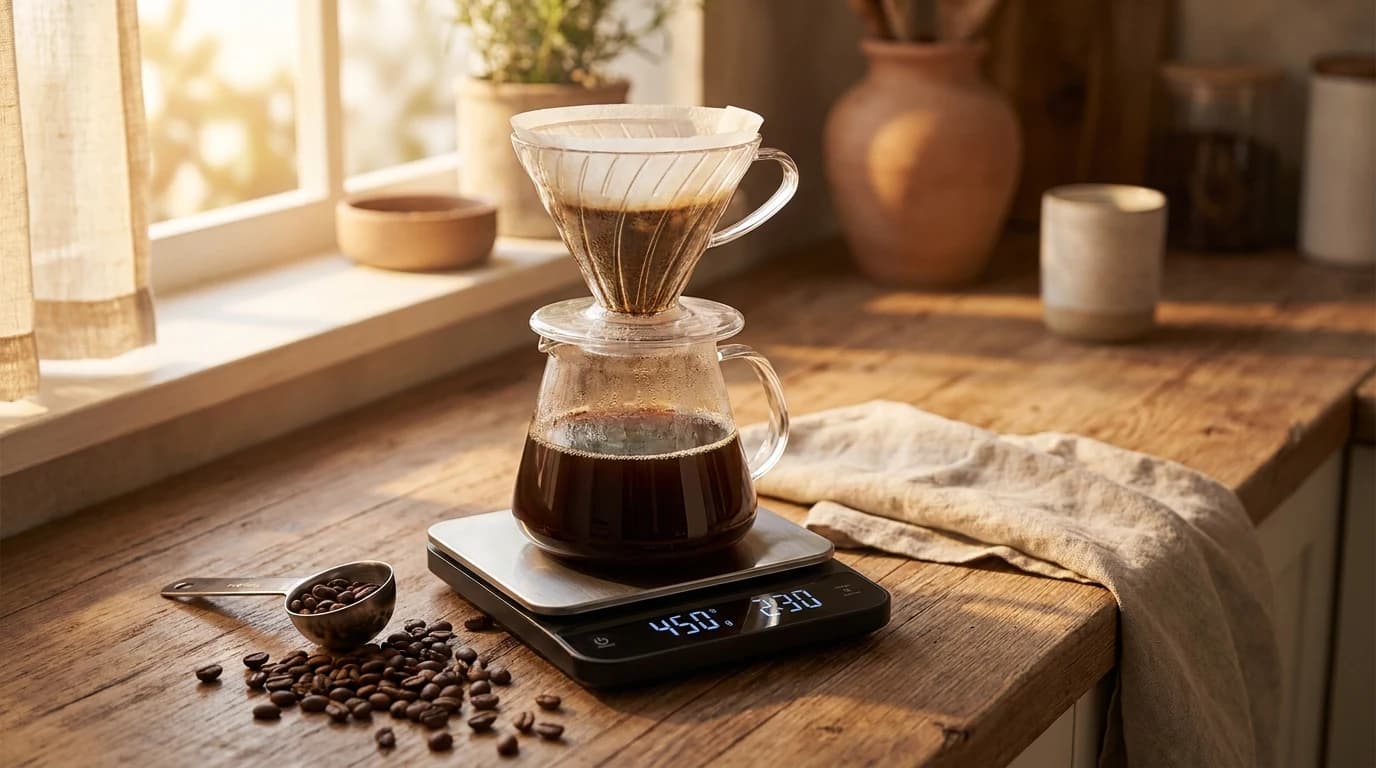
Key takeaways
- A scale's real job is not precision for its own sake; it removes the invisible day-to-day drift a scoop introduces, because one scoop can weigh 8 to 14 grams depending on roast and grind.
- It is transformative where the brew is fast and unforgiving (espresso at 1:2, pour-over at 1:14 to 1:16) and only marginal where a long steep and a wide ratio window absorb error (French press, cold brew).
- If your coffee is bad, a scale is rarely the first fix. An even grind, fresh beans, and better water each move flavor more than weighing a dose you are already roughly hitting.
- For most home brewers a 55 dollar 0.1g scale with a timer does everything the 165 dollar pro option does; you pay up only for flow-rate logging and a faster refresh.
You have probably watched a barista set a cup on a little screen, tare it, and pull a shot while staring at a number climbing. And you have probably wondered whether that gadget is doing real work or just performing precision. So here is the honest version, sorted by how you actually brew, because the true answer is not "yes, always" and it is not "no, it's snobbery." It is "it depends, and here is exactly on what."
The real question is not precision, it is drift
Most scale arguments get framed as accuracy: hit 18.0 grams instead of "about a scoop." That framing is why so many people tune it out, and they are half right to. Chasing a magic number is not the point.
Why a scoop lies to you
The point is drift you cannot see. A coffee scoop measures volume, but beans are round, uneven, and never settle the same way twice, so a single scoop can hold anywhere from 8 to 14 grams depending on roast level and grind size. Darker, oilier roasts are less dense; a finer grind packs tighter. That means a fixed "two scoops every morning" habit is quietly dosing anywhere from roughly 16 to 28 grams from one bag to the next, even though your hand did the exact same thing.
The falsifiable version: if your coffee is inconsistent day to day for no reason you can name, weigh your dose for a week without changing anything else. If the cup steadies, the scoop was your variable. A scale does not make coffee "correct." It removes an invisible source of noise.
Where a scale is transformative, and where it barely matters
A scale earns its keep in proportion to how fast and how unforgiving your brew method is. Fast, concentrated methods punish a few grams of error; long, dilute steeps swallow it. Map the scoop's 8-to-14-gram swing onto each method's ratio and the picture is clear:
| Brew method | Typical ratio (by weight) | Does a scale matter? | Why |
|---|---|---|---|
| Espresso | 1:2 (18g in, ~36g out) | Essential | Fast and pressurized; ~1g of dose visibly shifts the shot, and yield can't be judged by volume because of crema |
| Pour-over (V60, Kalita) | 1:14 to 1:16 | Transformative | Fast percolation, narrow window; the scoop swing alone can move you from ~1:11 to ~1:19 |
| Drip machine | 1:16 to 1:18 | Helpful | Forgiving, but a stable dose makes the machine repeatable |
| French press | 1:12 to 1:16 | Optional | Full immersion plus a wide ratio window absorbs a few grams |
| Cold brew | 1:5 to 1:8 | Optional | Long steep, high concentration; you dilute to taste anyway |
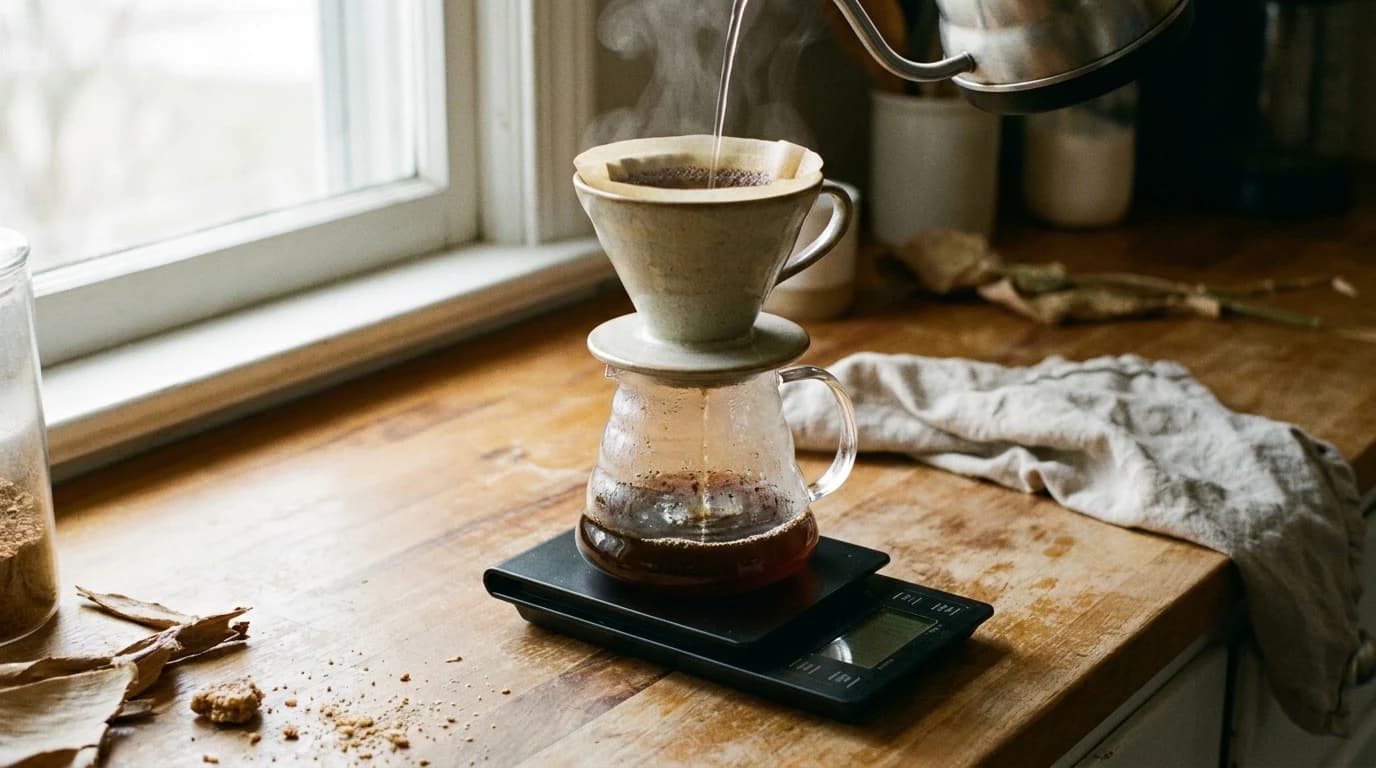
The pattern the gear roundups skip: the value of a scale is set by your brew method, not by how much you spent on your machine. A 600 dollar espresso setup dosed by scoop is more inconsistent than a 30 dollar pour-over cone dosed by weight.
What the scoop actually costs you
Take espresso, the least forgiving case. The standard starting point is a 1:2 ratio, 18 grams of coffee in and about 36 grams of espresso out, and dialing it in relies on holding the dose steady so you can read every other variable against it. Even a one-gram change in dose shifts saturation and flow through the puck, and because crema fakes volume you cannot judge yield by looking. Weighing to 0.1 grams is what turns "the shot tasted off today" into "I over-poured to 42 grams, pull it back."
The consistency test: keep your beans, grinder, water, and technique identical for a week and change only one thing, weigh the coffee in and the water or espresso out. If the cup stops swinging, you just found your biggest variable, and it cost you nothing but ten seconds a morning.
The honest flip side
In a French press at 1:12 to 1:16, the grounds steep for four minutes in a big margin of water, so a couple of grams off barely registers. Cold brew is looser still at 1:5 to 1:8, and you cut the concentrate to taste anyway. In those cups a scale is a nice-to-have, not a difference-maker, and anyone telling you it is essential for immersion coffee is selling gadgets.
Buy this before a scale
If your coffee is genuinely bad, not just inconsistent, a scale is usually not the first fix. In rough order of flavor impact for most home setups:
- A burr grinder. An even grind changes extraction more than a perfectly weighed dose you were already roughly hitting. Start at our grinders comparison.
- Fresh beans and better water. Stale coffee and hard tap water cap your ceiling no matter how precisely you measure.
- Then a scale, to lock in and repeat the good cup you can now make.
A scale is a consistency tool, not a flavor tool. It makes a good cup repeatable; it does not rescue a bad one.
Symptoms a scale fixes, and symptoms it won't
A scale is the answer when:
- The same beans taste different on different mornings
- You just opened a new bag and everything shifted
- You can't tell whether a change you made helped
- You want to repeat a cup you got right once
A scale is not the answer when:
- Every cup is consistently bitter or consistently sour
- The coffee tastes flat and stale regardless of dose
- Your grinder is a blade (fix the grinder first)
- You brew only French press or cold brew
If you do want one, what to actually look for
Three specs cover it: 0.1-gram resolution, a fast refresh, and a built-in timer. Everything above that is convenience.
- Best value for most people: the Timemore Black Mirror Basic 2 (around 55 dollars) gives 0.1g, a timer, and espresso and pour-over modes for well under half the price of the pro option.
- Pour-over specific: the Hario V60 Drip Scale (around 59 dollars) is sized for a V60 and carafe with a built-in timer.
- Espresso and data: the Acaia Pearl (around 165 dollars) adds a very fast refresh and flow-rate logging; pay up only if you will actually use the app; our Acaia Pearl vs Timemore Black Mirror comparison puts it against the value pick directly.
- Design and ratio coaching: the Fellow Tally Pro (around 200 dollars) calculates your brew ratio live and looks the part on the counter.
See how they score against each other on our scales comparison, and once you have one, our coffee ratio calculator turns any ratio into exact grams for your brew size. The takeaway: match the tool to the method. If you pull espresso or make pour-over, a scale is one of the highest-leverage 55 dollars you can spend. If you live on French press, spend it on beans instead.
Your next step
Ready to start weighing your brews?
The scales this post names
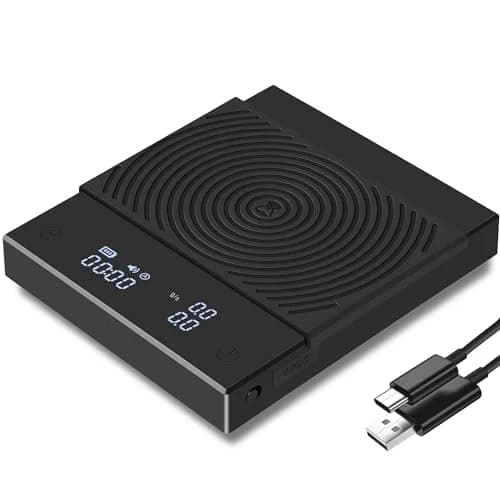
Black Mirror Basic 2
Acaia-style 0.1g performance and a fast refresh for less than half the price.
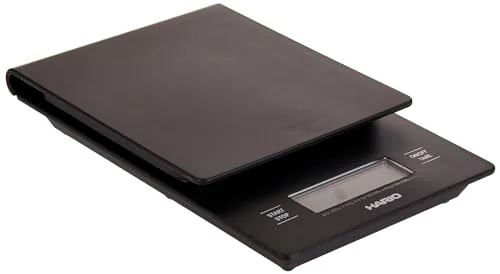
V60 Drip Scale (VST-2000B)
Hario's own pour-over scale — 0.1g resolution, a built-in timer, and a footprint sized for a V60 and carafe.
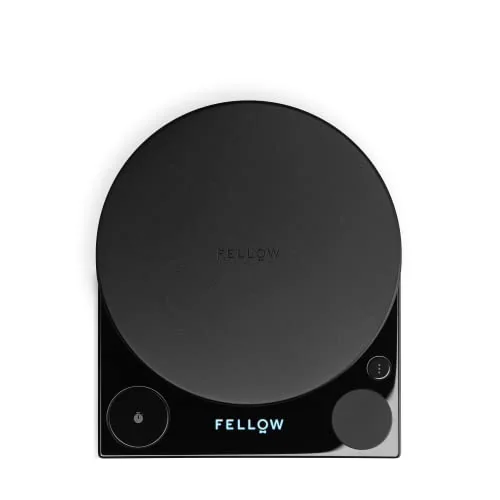
Tally Pro
Fellow's precision scale with brew-studio modes and the cleanest design on the counter.
BrewSift earns a commission on qualifying purchases made through these links, at no extra cost to you. Prices shown were checked on publication and change often.
FAQ
Do I really need a scale to make good coffee?
It depends on your method. For espresso and pour-over, where the brew is fast and a gram of dose swings the ratio, a scale is close to essential for repeatable results. For French press or cold brew, the long steep and wide ratio window (1:12 to 1:16, or 1:5 to 1:8) absorb small errors, so a scale helps but is not transformative. The honest answer is method-first, not gear-first.
How far off can a coffee scoop actually be?
A single scoop can hold anywhere from 8 to 14 grams depending on bean density, roast level, and grind size, because beans are round and never pack evenly. So a fixed two-scoops habit can quietly dose anywhere from 16 to 28 grams, a swing large enough to shift your ratio and your cup from day to day even when nothing feels like it changed.
What is the golden coffee ratio, and do I need a scale to hit it?
The SCA Gold Cup Standard puts it at 1:18 by weight, with most drip landing 1:16 to 1:18 and pour-over nearer 1:14 to 1:16. You can approximate it by volume, but ratios are defined by weight, so a scale is the only way to hit and repeat a specific one. Our coffee ratio calculator does the math for any brew size.
If I only buy one, should it be a scale or a grinder?
For most people with a bad cup, a burr grinder first. An even grind changes extraction more than a precisely weighed dose you were already roughly hitting. Buy the scale once your grind, beans, and water are handled and you want to make your results repeatable rather than better.