Roast your own green coffee at home and you get unbeatable freshness, total control, and dramatically cheaper specialty coffee. Home roasters range from popcorn-style air poppers to proper drum machines.
Quick steer — The deep end. Air roasters do small fast batches, drum roasters do bigger and more even ones — and you plan for smoke and chaff before you plan for the savings.
Top pick: Fresh Roast SR540 Coffee Roaster (8.9/10, Approx. $232.65). The friendliest way into home roasting — a fast air roaster with real heat and fan control, for about $230.
Skip this
Choosing a first roaster on batch size
Capacity is the specification listings lead with and the one that punishes beginners. Behmor's own quick start guide for the 1600 Plus tells owners never to start above a quarter pound and to run at least four quarter-pound batches before moving up, because a larger charge is slower, smokier and far less forgiving to learn on. Buy for the learning curve; the capacity will still be there next month.
The BrewSift Score is a 0–10 weighted average of category-specific sub-scores, built from manufacturer specifications, published reviews and aggregated owner reports — not hands-on testing. In this category it weights roast quality 30%, consistency 20% and ease of use 20%, plus 2 smaller factors. How we score →
The friendliest way into home roasting — a fast air roaster with real heat and fan control, for about $230.
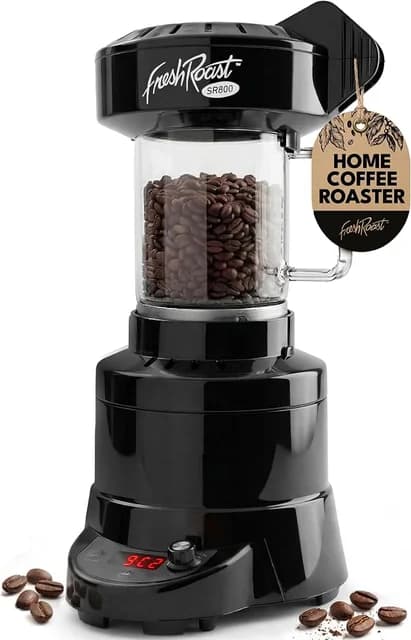
The SR540 is the entry point most home roasters recommend: a fluid-bed air roaster that roasts a small batch in minutes with independent heat and fan dials, so you learn to shape a roast without a big investment. Fresh, cheap, controllable specialty coffee at home.
The SR540's bigger sibling — roasts a larger batch and pairs with an extension tube for even more capacity.
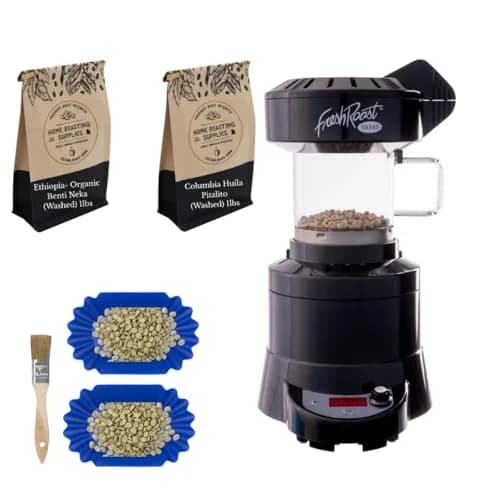
A fluid-bed air roaster: hot air lifts and turns the beans in a glass chamber, so you can watch the color change and hear first crack. Fresh Roast rates it for up to 8 oz (226 g) of green coffee per batch, less for chaffy dry-processed beans, with nine heat settings, nine fan settings and a real-time temperature readout on one knob, and a chaff collector on top. Air roasting is fast, usually under ten minutes, which suits people who want to experiment batch to batch. It still makes smoke, so plan on a vent hood or a window.
An enclosed roaster with a catalytic smoke reducer — the lowest-fuss, lowest-smoke way to roast indoors.
Nesco's roaster is an enclosed air roaster built around smoke control. Nesco's CR-1000-series use and care guide describes a two-speed fan that pushes heated air through up to 5 oz of green coffee while an auger stirs the beans, and a patented catalytic converter that the maker says removes the smoke and most of the odor. Roasts are timed rather than profiled: the default is 20 minutes for a light roast, Nesco suggests 25 as a starting point and allows up to 35, and a 5-minute cooling cycle follows. Nesco also says never to leave it unattended.
No longer in Behmor's lineup, which now lists the 2000AB Plus, though Behmor still sells a 1600 Plus upgrade kit. A drum roaster rated for up to a pound per batch, with smoke suppression and five power profiles.
Behmor's drum roaster runs to a one-pound batch, with default roast times set for quarter-, half- and one-pound loads, five profile buttons (P1 to P5) that set heating power, and a manual mode you can drop into mid-roast. Its smoke suppression is what makes indoor roasting practical, and a spring-loaded chaff tray catches the skins. Behmor's own quick-start guide tells new owners to begin with quarter-pound batches, and its current lineup lists the 2000AB Plus, which keeps the one-pound capacity and five pre-programmed profiles, rather than the 1600 Plus; Behmor still publishes support and upgrade kits for the 1600 family. There is no trusted Amazon listing for it right now.
A budget electric stir-type roaster with adjustable temperature and a glass lid — a cheap way to roast a bigger batch you can watch.
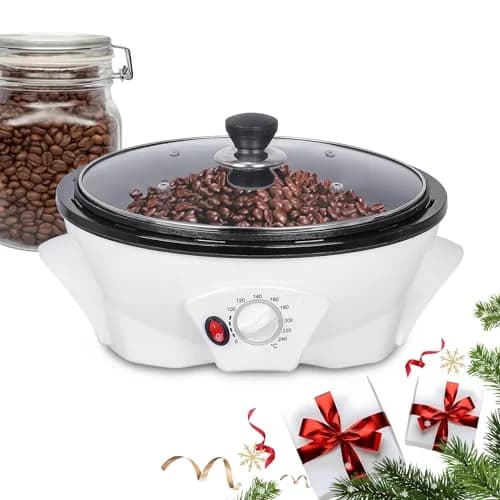
A countertop electric roaster in the stir-and-heat style rather than a true drum: an automatic stirring arm turns the beans on a heated non-stick pan under a glass lid with four vent holes, so you can watch and smell the roast as it goes. The listing gives an adjustable 100 to 240 °C temperature, a 1,200 W element, a best batch of 300 to 500 g of green coffee, with a warning that under 300 g roasts unevenly, and about 25 minutes per roast. There is no smoke control beyond the vent holes, so plan ventilation as you would for any roaster.
The machine that holds a pound tells you not to use a pound. Behmor's quick start guide for the 1600 Plus is explicit that you should never begin above a quarter pound and should run at least four quarter-pound batches first, and it publishes a different first-crack-to-second-crack interval for each charge size — 1:30 at a quarter pound against 3:10 at a full one. Roast time does not scale with the batch, which is the part that catches people who bought on capacity.
What owners actually report
r/roastingr/Coffeer/espresso
r/roasting's recurring advice to newcomers is to start small and cheap, because the thing that stops most people is not the machine, it is the smoke and the chaff. Air roasters, the FreshRoast line above all, are the standard first recommendation for being fast, visible and forgiving, with the standing caveat that the glass chamber is fragile and the batch is small enough to become a chore if you are supplying a household. Drum machines like the Behmor are described as the step you take when you want bigger, more even roasts and are willing to learn a slower machine. The two warnings the sub repeats hardest are about extraction and about degassing: roast somewhere you can vent, and do not brew the coffee the same day. Threads are also consistently honest that the money argument is weaker than people expect once green shipping and the machines that get replaced are counted in.
Consistently praised
FreshRoast SR540 and SR800 — The standard first recommendation: independent heat and fan control, a visible glass chamber and a perforated chaff collector. Sweet Maria's puts the SR540's maximum batch at around 5 oz (140 g) with nine heat and nine fan settings.
Behmor drum roasters — Recommended for people who want bigger, more even roasts; owners cite the profile programs and the drum's evenness and accept a much slower cycle in return.
Popcorn-popper roasting — Still the most repeated cheap experiment in these threads, recommended precisely so that you find out whether you enjoy the process before spending on a machine.
Consistently warned about
Roasting indoors without ventilation — The most repeated regret in the sub. Sweet Maria's notes the SR540 has no smoke reducer and that roasting under a range hood works in most but not all cases.
Starting with a full-size charge — Behmor's own guide tells 1600 Plus owners never to begin above a quarter pound, and the threads echo it: a large first batch is the fastest route to a scorched, smoky roast.
Brewing on roast day — Owners consistently report flat, gassy cups from same-day coffee and advise resting the beans a few days before judging the roast at all.
What we didn't pick
Popular options we looked at and passed on, with the specific reason each one fell short.
Hot-air popcorn poppers sold as coffee roastersConsidered 2026-09
A genuinely good way to find out whether you enjoy roasting, and the route most owners start on. But a popper has no independent heat and fan control and no chaff containment, so it belongs in this guide as an experiment rather than as ranked equipment.
One-button roasters with sealed profilesConsidered 2026-09
The appeal of roasting at home is control over the curve, and a machine that hides the curve leaves you with an expensive way to make roasted coffee you could have bought roasted. Where a machine publishes no way to alter heat or airflow mid-roast, we leave it out.
Countertop roasters marketed as smokelessConsidered 2026-09
The claim generally describes a catalytic or filtered exhaust that reduces visible smoke rather than removing it. Sweet Maria's is straightforward that the SR540 has no smoke reducer at all and that a range hood is the answer, and we would rather say that plainly than rank a machine on a word that sets the wrong expectation. Source.
No longer in Behmor's lineup, which now lists the 2000AB Plus, though Behmor still sells a 1600 Plus upgrade kit. A drum roaster rated for up to a pound per batch, with smoke suppression and five power profiles.
The five home roasters BrewSift ranks run $37 to $400, a 10.8x spread, and what the money buys is batch size and control over the curve rather than a better roast — the curve is yours to drive either way.
Air vs drum
Air (fluid-bed) roasters like the FreshRoast SR line are fast, cheap, easy to learn, and great for small batches — hot air both roasts and tumbles the beans, so heat-up is quick and roasts finish in 5 to 9 minutes. Drum roasters like the Behmor 1600 hold more, roast more evenly, and give a more 'developed', body-forward roast that many enthusiasts prefer — but they cost more, take longer, and have a steeper learning curve. Beginners almost always start with air for the price and forgiveness, then move to a drum when they want bigger batches and finer control.
How to roast coffee at home, step by step
The method is the same whichever machine you use; only the controls differ. Start small: Behmor's quick start guide tells new owners never to begin above a quarter pound and to run several quarter-pound batches first. Load the green beans, start the roast and stay with the machine, because Behmor and Nesco both say never to leave a roaster unattended. Listen for first crack, the popping that marks the start of a light roast; from there every extra minute takes the beans darker, and Behmor puts the gap from first crack to the start of second crack at about 1:30 for a quarter pound and 3:10 for a full pound. For its practice roasts Behmor says to press cool once you hear second crack begin, and to stop at once if you see heavy or bluish smoke. Cool the beans quickly, which machines do with a cooling cycle (Nesco runs five minutes), then let them rest a few days before judging the roast.
Batch size sets your rhythm
Most air roasters do only 4 to 8oz of green per batch, which becomes maybe two to four days of coffee — fine for a solo drinker chasing peak freshness, tedious if you're supplying a household. Drum and larger fluid-bed machines handle a half-pound to a pound at a time. Buy for how much you actually drink: green weight loses roughly 15 to 20 percent as moisture cooks off, so 8oz of green yields closer to 6.5oz roasted.
Plan for the smoke
Roasting produces smoke and chaff, and it climbs sharply as you push past first crack toward darker roasts. Roast under a range hood vented outside, in a garage, or outdoors — an open kitchen window is rarely enough. Read what each maker actually claims, because the wording differs. Nesco says the CR-1010-PR routes its exhaust through a patented catalytic converter that removes the smoke and most of the odor. Behmor lists smoke suppression technology on its current drum roaster, and its quick start guide still treats heavy or bluish smoke as the sign to stop the roast. Sweet Maria's states the Fresh Roast SR540 has no smoke reducer and that a range hood works in most but not all cases, and the JIAWANSHUN's listing describes four vent holes in its glass lid and nothing more. No home roaster is truly smoke-free at medium-dark and beyond. This is the single thing beginners underestimate most.
Control vs automation
Entry roasters run on presets or simple time-and-temperature dials, which is plenty to make good coffee. As you get serious, the feature that matters is manual control over heat and airflow mid-roast, plus a way to log or profile the curve — that repeatability is what lets you dial in a bean and hit the same result twice. If you already know you'll chase profiles, buy a machine with adjustable heat and airflow rather than fixed presets you'll outgrow in a month.
Is the math worth it
Green coffee runs a fraction of the price of roasted specialty beans per pound, so a roaster can pay for itself over a year or two if you drink good coffee daily. But freshness is the real draw: home-roasted coffee is at its peak days after roasting, a window you almost never get buying retail. Treat the savings as a bonus and the freshness plus control as the actual reason — that framing keeps expectations honest.
Fluid bed, drum and smokeless: what the words on the box mean
Three terms do most of the work in roaster listings. Fluid bed is the technical name for an air roaster: a column of hot air both heats and tumbles the beans, which is why the FreshRoast SR540 and SR800 heat quickly, finish in minutes and let you watch the colour change the whole way through. Their batch sizes, roughly 120g and 230g of green, tell you the rhythm you are signing up for. Drum means the beans turn in a heated cylinder rather than floating, which holds more and develops body, and the Behmor here is that pattern. The JIAWANSHUN is a cheaper relative rather than a true drum: its listing describes a stirring arm turning the beans on a heated pan under a glass lid. One disclosure on the Behmor: the 1600 Plus we rank has been superseded in Behmor's own lineup by the 2000AB Plus, which keeps the one-pound capacity and smoke suppression, and Behmor still sells upgrade kits and parts for the 1600 family; we have no trusted Amazon listing for it right now. Smokeless is the term to treat carefully, because no home roaster is genuinely smokeless past a medium roast. What the machines sold that way have is smoke reduction: Nesco says the CR-1010-PR's catalytic converter removes the smoke and most of the odor, and still tells owners never to leave it unattended. Plan ventilation regardless of what the box claims, and note that green coffee loses roughly 15 to 20 percent of its weight in the roast, so batch figures are green weight rather than the coffee you end up with.
FAQ
Common questions
Is roasting coffee at home worth it?
For the right person, yes. You get coffee at genuine peak freshness — something you can't buy — plus total control over roast level and meaningful savings versus retail specialty beans, since green coffee costs far less per pound. The catch is time and smoke: small batches mean roasting every few days, and it's a smoky, chaff-shedding process that needs ventilation. If you love the craft and drink good coffee daily, it's rewarding; if you just want convenience, a grinder and fresh beans from a good roaster is the easier win.
What's the difference between an air roaster and a drum roaster?
An air (fluid-bed) roaster uses a stream of hot air to both heat and tumble the beans — it's fast, inexpensive, easy to learn, and best for small batches, but it tops out at a few ounces and gives a brighter, cleaner roast. A drum roaster rotates the beans inside a heated drum, more like a scaled-down commercial machine: bigger batches, more even and 'developed' roasts with more body, but higher cost and a longer learning curve. Most people start with air and graduate to a drum when they want more capacity and control.
How long does home-roasted coffee last?
Freshly roasted coffee needs a day or two to rest and degas before it brews well, then it's at its best for roughly two to three weeks kept in an airtight, opaque container at room temperature. It doesn't spoil after that, but the aromatics fade and the cup goes flat. Don't roast more than you'll drink in a few weeks, and never refrigerate whole beans — the humidity and odor swings do more harm than the age would.
Can I roast coffee at home without a dedicated roaster?
You can, though a real roaster makes it far more consistent. People roast small batches in a stovetop popcorn popper, a cast-iron pan with constant stirring, or an air popcorn popper — all of which work and cost almost nothing to try. The trade-offs are uneven roasting, little control over the profile, and the same smoke and chaff you'd get from a machine. It's a great way to learn whether you enjoy roasting before committing to a dedicated air or drum unit.
How much green coffee do I need per batch?
It depends on your machine — small air roasters take about 4 to 8oz of green per batch, while drum and larger fluid-bed roasters handle a half-pound to a pound. Remember that beans lose roughly 15 to 20 percent of their weight as moisture during roasting, so weigh your green accordingly: 8oz of green comes out around 6.5oz roasted. Buy green in bulk since it stays stable for months, and roast in the small batches your machine is built for.
How do you roast coffee beans at home?
Start with a small batch, a quarter pound or less, and stay with the machine the whole time. Heat the green beans until you hear first crack, the popping that marks a light roast, then decide how much further to go: every extra minute takes the beans darker, and Behmor's quick start guide puts the gap from first crack to second crack at about a minute and a half for a quarter pound. Stop by the start of second crack while you are learning, cool the beans quickly, and let them rest a few days before you judge the result.
Can you roast coffee indoors without smoke?
Not entirely. Nesco says its catalytic converter removes the smoke and most of the odor, and Behmor lists smoke suppression on its drum roaster, so those two are the most indoor-friendly here. Air roasters like the Fresh Roast SR540 have no smoke reducer, per Sweet Maria's, and need a range hood. Smoke rises sharply as you roast past first crack toward darker roasts, so light and medium roasts are the easier ones to do indoors, and a vented hood is the plan for everything else.